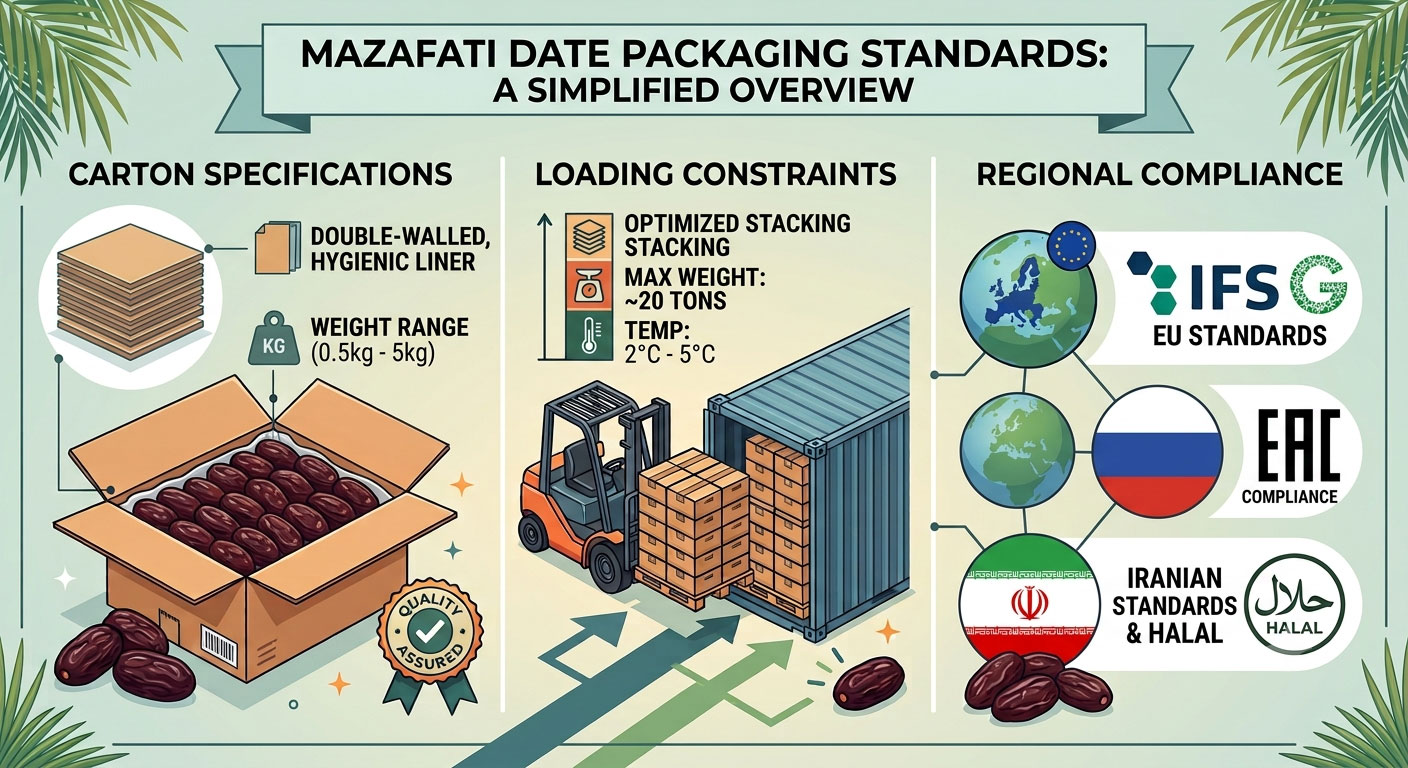

- 5kg and 10kg telescopic cartons use 3–5 ply flute board with waterproof kraft inner lining.
- A 40ft container holds approximately 25 net tons, whether floor-loaded or pallet-loaded.
- Custom-branded packaging needs 24 days lead time; IML-printed plastic needs 45 days, against full prepayment.
- Standard wooden pallets are not ISPM-15 treated by default — treatment is a buyer add-on.
- Reefer transport extends dried Mazafati shelf life from 18 months to 24+ months versus dry container shipping.
Container Load & Payload Calculator
To streamline your import planning, we have integrated the PERSA Container Loading Calculator below. Simply select your date variety, packaging type, and loading method to instantly determine the optimal carton quantity and maximum allowable cargo weight for 20ft or 40ft containers. This tool automatically factors in pallet weights and structural container limits, helping you maximize freight efficiency while strictly complying with Verified Gross Mass (VGM) regulations to avoid costly customs delays at destination ports.
Container Loading Calculator
Loading Summary
- Config: 🚢 20ft Container, ❄️ Reefer (🧱 Floor-Loaded)
- Gross Wt (Customs): 17,998.2 Kg
- Net Wt: 16,665 Kg
- Transport Temp: < 0 °C
- Shelf Life: 12 Months
Call to finalize order now
Why Packaging Format Depends on Moisture, Not Just Market Preference
Critical Insight — the rule most guides miss: Packaging selection for Mazafati dates is not a branding decision first. It is a moisture-management decision first. The wetter the date, the narrower the list of packaging formats that will survive a container voyage without leaking, fermenting against the cardboard, or crushing under its own weight.
Grade 1 Mazafati, harvested wet with 20–25% moisture, almost never goes into bulk packaging. The flesh is too soft. Under stacking pressure inside a bulk box, the fruit releases its own syrup, and the load turns into a sticky mass at the bottom of the carton. This is why bulk packaging is reserved for drier varieties and grades: Zahedi, Rabbi, Piarom, Kalute, Khanizi, Kabkab, and Sayer dates, along with Mazafati Grade 2 and Grade 3, which carry less moisture and a firmer flesh structure that tolerates pressure without releasing juice.
Shahani dates are the exception that proves the rule. The skin is thin and detaches easily from the flesh, so before bulk packing, we polish it with paraffin oil. The oil itself has a fixed specification: it must be food and medical grade, colorless, odorless, and fully transparent. We send product samples to government laboratories to obtain health and sanitary certification before this process goes into production. The same polishing step is also used on Rabbi, Mazafati Grade 2/3, Kalute, and Kabkab dates — it removes surface dust and restores a glossy appearance that some markets specifically request.
This single fact — moisture dictates format, not the other way around — is the reason a generic export packaging checklist written for textiles or electronics is close to useless for dates. The packaging engineering question for Mazafati starts in the orchard, at the (Dry date/Tamar) ripening stage, not at the print shop.
🎧
Audio Companion: Inside the World of Date Logistics
Click play to explore practical insights, cost comparisons, and supply chain technicalities that complement this article in a dynamic, easy-to-digest conversation.
Bulk Packaging
Bulk packaging serves two buyer types: retailers who sell loose dates by weight, scooped into a consumer’s own container, and processing workshops that re-sort, re-pack, or convert the dates into paste, syrup, or other derivative products. There is no retail unit inside the box — just product, loaded to the practical weight limit of the carton or sack.
The varieties used here are the drier grades listed above. Drier flesh means less internal pressure on the box walls, less risk of syrup pooling at the bottom, and less risk of mold developing in trapped moisture pockets during transit.
Retail & Mother-Carton Packaging System
This is where most of the engineering complexity sits, and where buyers usually have the most questions. Below is each format PERSA produces, with the dimensions that matter for container math and quality control.
5kg and 10kg Telescopic Cartons (Cellophane Laminated)
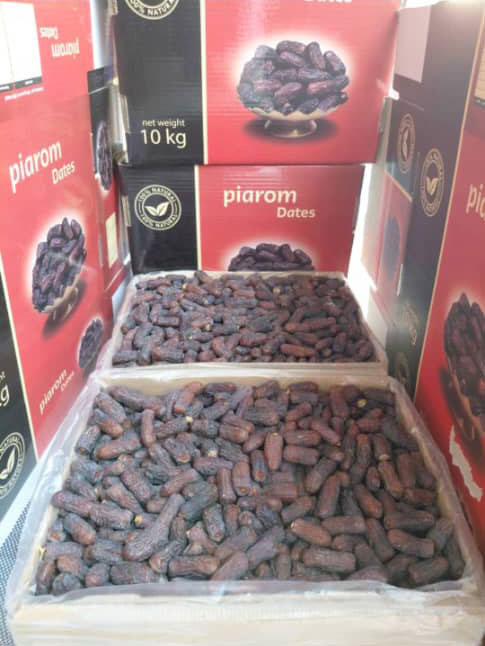
| Spec | 5kg Carton | 10kg Carton |
|---|---|---|
| Lid length | 39.4 cm | 42.2 cm |
| Lid width | 26.5 cm | 32.9 cm |
| Lid height | 9.9 cm | 11.8 cm |
| Lid board | 4-ply, C-flute | 4-ply, C-flute |
| Base length | 37.2 cm | 41.5 cm |
| Base width | 25.1 cm | 29.5 cm |
| Base height | 9.8 cm | 11.8 cm |
| Base board | 3-ply, C-flute | 5-ply, B/T-flute |
| Inner liner | Waterproof kraft | Waterproof kraft |
Insight box: We shrink-wrap every telescopic carton at loading time, regardless of destination. This single step is the largest reduction in transit damage we see across our shipment history — it is cheap insurance against box-lid separation during handling at transshipment ports.
500g, 4×4 Retail Box — The Format That Defined the Category
This format has a documented origin point. The Kimia brand introduced the 4×4-arranged small box from Iran in the 1990s, and it became the reference format for exporting branded Mazafati. Nearly every Mazafati exporter today still ships a version of it.
The arrangement differs by destination. Western Asian markets generally buy the 4×4, 2-layer configuration. Most other markets buy the 4×4, 3-layer version. Twelve of these small boxes go into one mother carton.
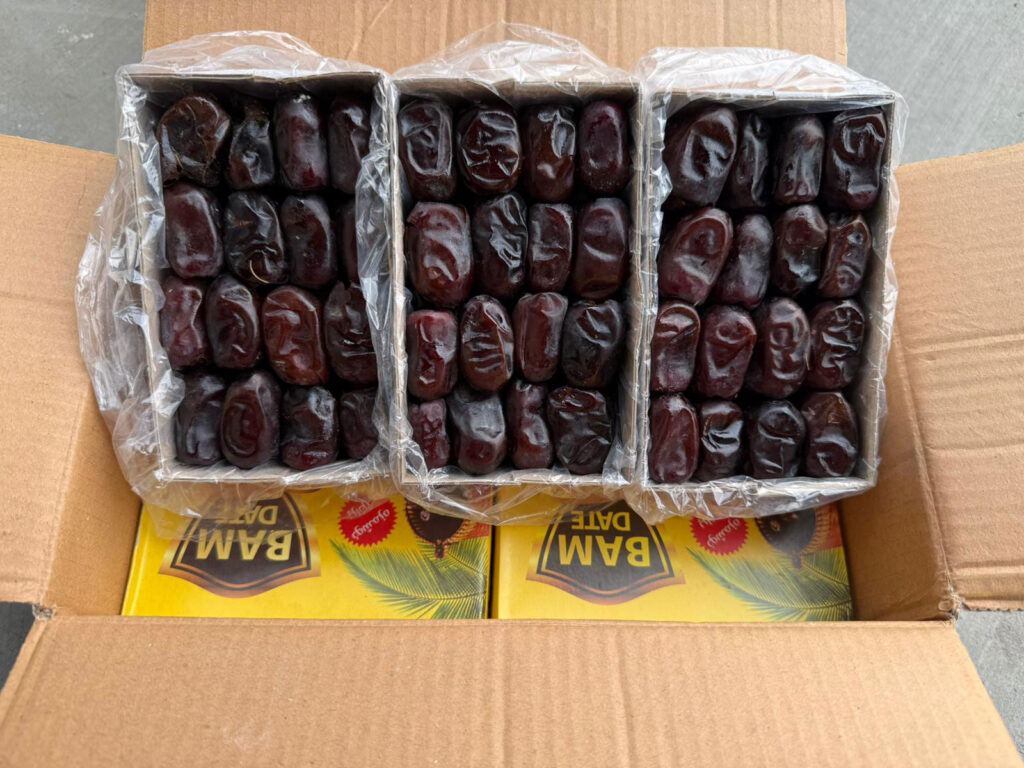

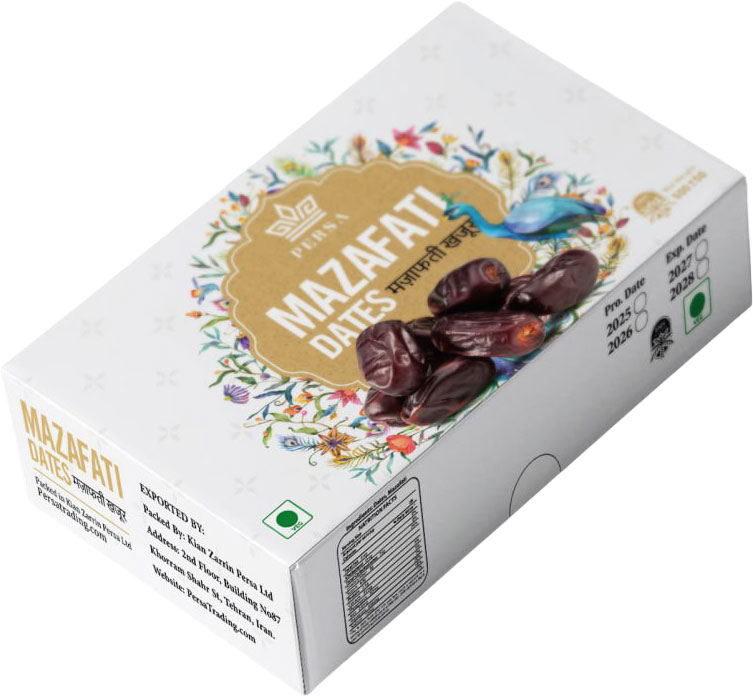
| Spec | 500g Small Box | Mother Carton |
|---|---|---|
| Capacity | 500g | 12 units |
| Lid dimensions | 15.7 × 9.7 × 3.3 cm | 33 × 20.5 × 18 cm |
| Lid material | 230g offset-printed paper | 4-ply, C-flute |
| Base dimensions | 15.1 × 9.3 × 5.7 cm | — |
| Base board | 3-ply, E-flute | — |
Typical fill: Mazafati Grade 1 and Grade 2, Piarom, Kalute, and Kabkab are arranged neatly by hand. Zahedi and Rabbi are sold loose-filled inside the same box format, without hand arrangement.
Two construction variants exist. The unbranded “agricultural carton” uses staples to join the lid and base and sells at a lower price point. The branded version comes in two sub-types: a stapled “keyboard-lid” box, or a four-point-glue origami construction with no staples or metal at all — the version we recommend for markets sensitive to metal-detection screening at customs or retail.
Plastic Clamshells — 650cc and 1000cc
| Spec | 650cc Box | 1000cc Box |
|---|---|---|
| Length | 16.5 cm | 19.4 cm |
| Width | 11.6 cm | 13 cm |
| Height | 6.3 cm | 6 cm |
| Best for | High-density dates (Mazafati, Kalute, Rabbi, Piarom), up to 500g | Lower-density dates (Zahedi, Shahani), 500g |
| Mother carton | 33.2 × 23.2 × 19 cm, 4-ply | 38.8 × 26 × 18 cm, 4-ply |
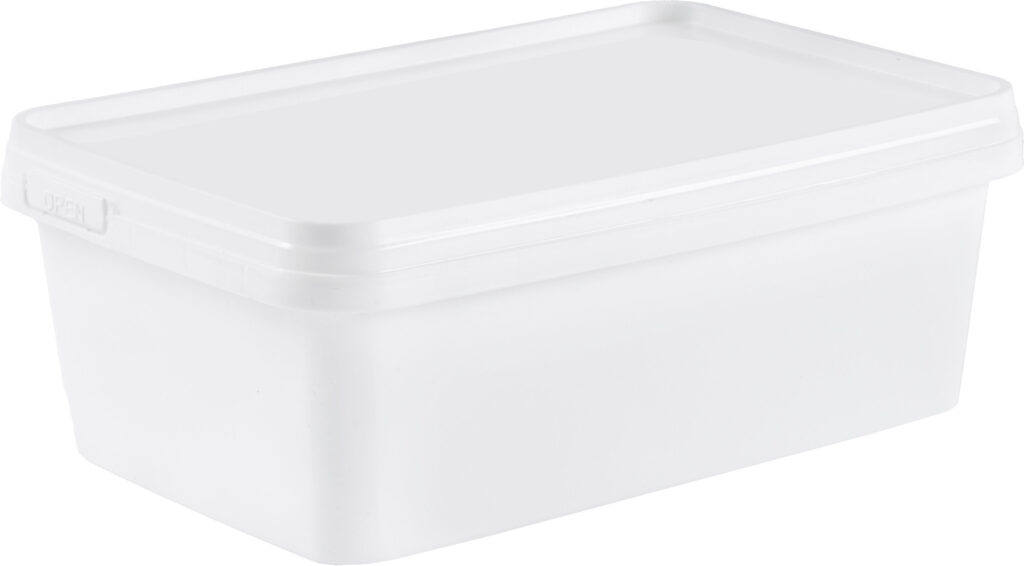
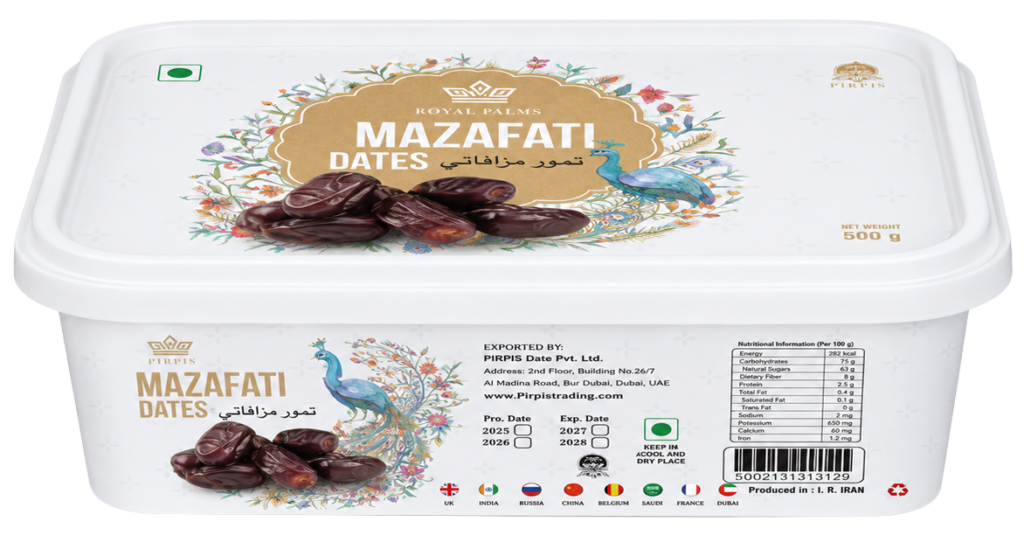
The clamshells come transparent or colored, and we can mix — a clear lid with a colored body, for example. For lower-budget branding, a moisture-resistant adhesive label on the lid and body works well. For premium presentation, IML (in-mold labeling) prints the design directly into the plastic itself; it cannot be removed without damaging the container.
Doypack Stand-Up Pouches
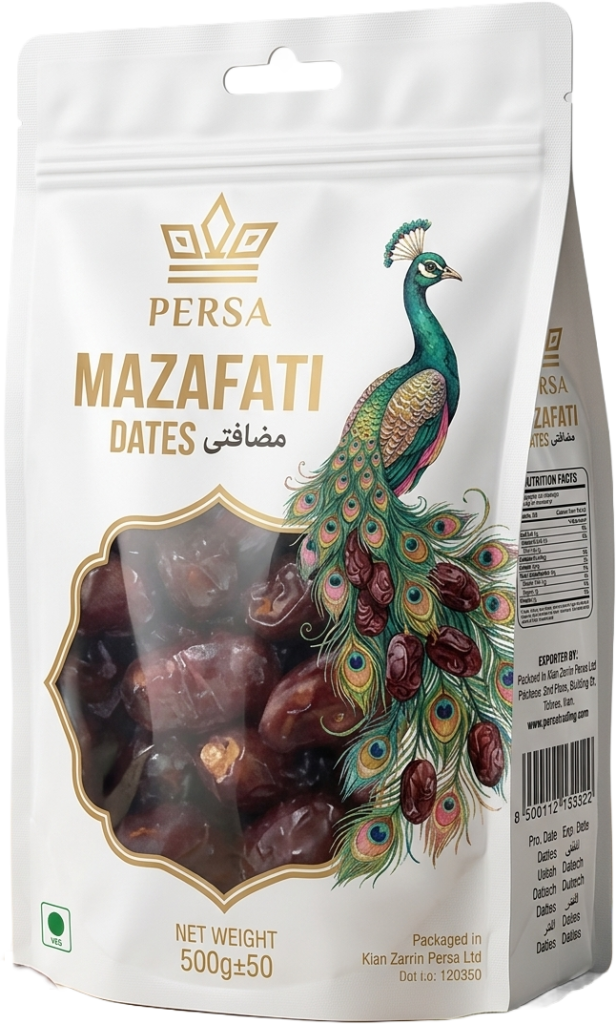
The doypack format suits drier varieties: Mazafati Grade 2, Kalute, Rabbi, Sayer, Zahedi, and Piarom. Standard fill is 200–250g, with the most common pouch measuring 17 cm tall, 11 cm wide, and roughly 3 cm in body thickness. A clear window panel lets the buyer inspect the quality before purchase.
Matchbox Sliding-Sleeve Pack
This is the premium tier — an open-ended sleeve box that a shrink-wrapped inner tray slides into, like a matchbox. A window cut into the sleeve allows quality inspection through the shrink wrap. It is most associated with Piarom dates, given the variety’s price position, though it also works for Mazafati, Rabbi, and Kalute. Each box holds roughly 400g, with 12 boxes per mother carton.
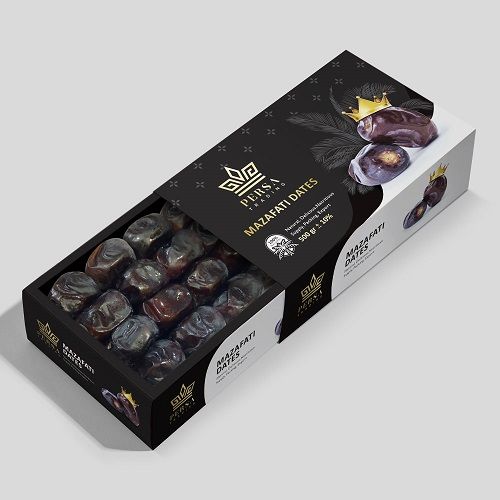
| Spec | Value |
|---|---|
| Length | 18 cm |
| Width | 12 cm |
| Height | 5 cm |
Pressed Block Packaging (2kg / 3kg)
Kabkab and Shahani dates are typically pressed into blocks rather than packed loose, because their thin skins make broken or low-grade pieces easy to hide once pressed, and pressing is cheaper than the alternatives, which is reflected directly in the pricing data below.
Standard configuration: six small boxes (2kg or 3kg each) inside one mother carton, giving 12kg or 18kg net weight per master unit. Carton material can be upgraded to reinforced board with cellophane lamination on request. At load time, these cartons get strapped rather than shrink-wrapped — the extra weight makes strapping easier for warehouse staff to handle and stack safely.
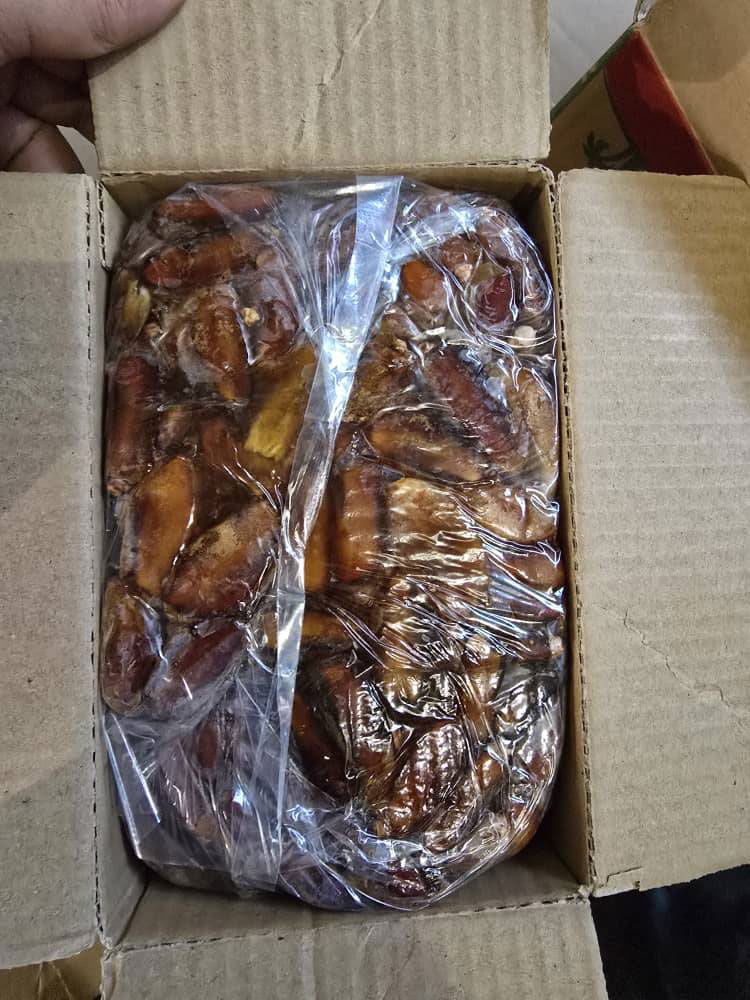
Vacuum-Sealed Packaging
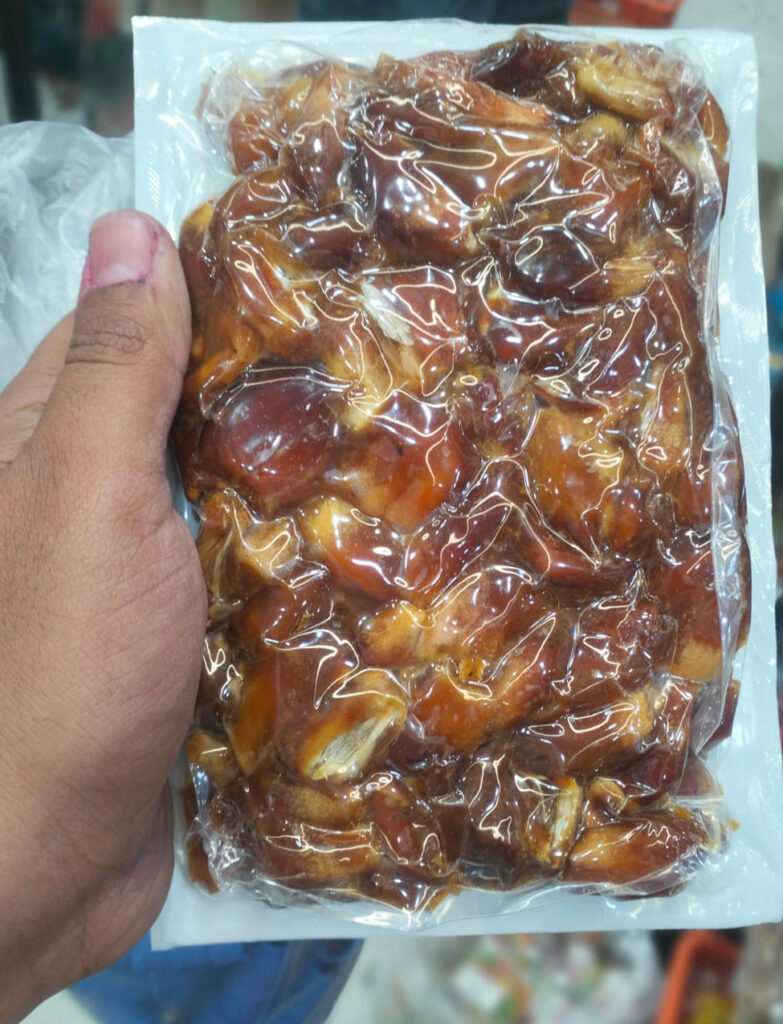
Dates go into disposable trays, which are then sealed with a foil-seal machine. The main operational advantage is mold flexibility — the same sealing equipment adapts to different tray shapes without retooling.
Pricing Logic — What Each Format Actually Costs
These are PERSA’s component costs as of this writing, converted at today’s Iranian free-market USD rate of 166,000 Toman per dollar. Exchange-rate movement in Iran can be sharp, so treat the Toman figures as the durable reference and the USD figures as a snapshot for comparison only.
| Component | Toman | Approx. USD |
|---|---|---|
| 5kg telescopic carton | 80,000 | $0.48 |
| 10kg telescopic carton | 110,000 | $0.66 |
| Mother carton (empty) | 85,000 | $0.51 |
| Small box, unbranded | 6,000 | $0.04 |
| Small box, branded (stapleless) | 8,000 | $0.05 |
| Plastic box, labeled | 18,000 | $0.11 |
| Plastic box, IML printed | 20,000 | $0.12 |
| Matchbox sleeve | 15,000 | $0.09 |
| 2kg pressed set (6 boxes + mother) | 76,000 | $0.46 |
| 3kg pressed set (6 boxes + mother) | 90,000 | $0.54 |
A mother carton needs 12 small units, so the full retail master-carton cost varies more sharply than the per-unit numbers suggest:
| Retail format (12 units + mother carton) | Total cost | Approx. USD |
|---|---|---|
| Unbranded retail | 157,000 T | $0.95 |
| Branded, stapleless | 181,000 T | $1.09 |
| Plastic + adhesive label | 303,000 T | $1.83 |
| Plastic + IML print | 323,000 T | $1.95 |
| Matchbox premium | 264,000 T | $1.59 |
Insight box: The spread between the cheapest master carton (unbranded retail, $0.95) and the most expensive (IML plastic, $1.95) is roughly 2x. That gap is packaging cost alone — it has nothing to do with the date variety inside the box. Buyers comparing supplier quotes should always confirm which packaging tier is built into the price before comparing per-kilogram numbers across suppliers.
Container Loading: Floor-Loading vs. Pallet-Loading
Cold Chain Storage & Container Selection: Dry vs. Reefer
Before any carton decision, storage temperature already does most of the work. We hold both Rotab (fresh, soft dates) and dried dates in cold storage at -10°C with 0% humidity, which is the baseline that protects shelf life before the product ever reaches a container.
Dried dates (moisture under roughly 15%): these can travel in a standard dry container during cold-weather months, with no reefer required. That said, reefer transport is not just a moisture-control tool for this category — it is a shelf-life tool. Shipping dried Mazafati in a reefer extends shelf life from 18 months in a dry container to 24 months or more.
Rotab and semi-dry dates (moisture above 15%): these require a reefer container. Our recommended setting is -2°C to 0°C, ventilation off, and 0% humidity. Typical transit runs one to three weeks, depending on the route, and this setting is what keeps the product’s quality unchanged across that window.
Insight box: The moisture threshold that decides bulk vs. retail packaging earlier in this guide is the same threshold that decides dry container vs. reefer here. Above roughly 15% moisture, both the packaging format and the container type change. Below it, both open up to cheaper, simpler options — but only the reefer option adds a shelf-life bonus on top of moisture protection.
EAEU Technical Regulation Compliance
For buyers in Russia, Kazakhstan, Belarus, Armenia, and Kyrgyzstan, packaging and labeling fall under the EAEU’s technical regulation (TR CU) system. The frameworks most relevant to date exports, and how PERSA addresses each, are below.
| Regulation | Covers | PERSA’s practice |
|---|---|---|
| TR CU 021/2011 | Food safety | No staples or metal components used in packaging; samples are sent periodically to government laboratories for evaluation. |
| TR CU 022/2011 | Labeling | Mandatory product, exporter, and importer details, plus required warnings, are printed or labeled on every bulk and mother carton shipped. |
| TR CU 029/2012 | Additives and flavorings | Not applicable — PERSA’s date products are 100% natural with no additives. |
| TR CU 005/2011 | Packaging | Addressed by the carton and packaging specifications detailed earlier in this guide. |
Regulation numbers and titles above are stated as provided by PERSA. We recommend cross-checking the exact current titles against the official EAEU technical regulation register before this is treated as a final compliance reference for a specific shipment.
Customization Lead Times
Printing and packaging timelines stack, and buyers planning shipment dates around a harvest window need both numbers, not just one.
Standard branded cartons: Production printing takes a minimum of two weeks. Packing or re-packing into the printed cartons takes another 10 days. Total: 24 days.
IML custom plastic printing: Because the print is molded into the plastic itself rather than applied afterward, production needs a minimum of five weeks. Packing adds another 10 days. Total: 45 days.
Custom production with a buyer’s own brand and design requires full prepayment for printing and production costs before the order is started. This applies to both the 24-day and 45-day timelines above.
This is the single biggest planning gap we see in buyer timelines — many importers request IML packaging on a schedule built for standard cartons, then are surprised by a near-doubling of lead time on top of the prepayment requirement.
Frequently Asked Questions
Why don’t premium wet Mazafati dates ship in bulk packaging?
Grade 1 Mazafati carries 20–25% moisture and a soft flesh structure. Under the weight pressure of bulk packing, the fruit releases syrup and the load degrades. Bulk format is reserved for drier varieties and lower grades.
What’s the practical difference between 650cc and 1000cc plastic date containers?
650cc suits denser, juicier varieties like Mazafati, Kalute, Rabbi, and Piarom, holding up to 500g. 1000cc suits lower-density varieties like Zahedi and Shahani, also at 500g — the lower density needs more volume for the same weight.
How many tons of packaged Mazafati dates fit in a 40ft container?
Roughly 25 net tons, whether floor-loaded (up to the container’s stated gross weight limit, around 30.5 tons) or pallet-loaded with 20 pallets at 110×110cm each.
Are PERSA’s wooden pallets ISPM-15 treated by default?
No. Standard wooden pallets are not heat-treated or fumigated under ISPM-15. Treatment is available as a buyer-requested add-on and should be confirmed at order time if your destination market requires it.
Is the paraffin oil used to polish dates safe for food contact?
PERSA uses food and medical grade paraffin oil that is colorless, odorless, and transparent. Product samples are sent to government laboratories to obtain health and sanitary certification before use.
How much longer does IML-printed packaging take compared to standard branded cartons?
Standard branded cartons take 24 days total. IML plastic printing takes 45 days total — almost double, because the print is molded into the plastic rather than applied as a label. Custom branded production also requires full prepayment before printing and packing begin.
Can dry Mazafati dates ship in a standard dry container instead of a reefer?
Yes, dried dates with moisture under roughly 15% can ship in a standard dry container during cold-weather months without a reefer. Rotab and semi-dry dates above 15% moisture require a reefer set to -2°C to 0°C with ventilation off and 0% humidity.
Does reefer transport extend the shelf life of dried dates?
Yes. Dried Mazafati shipped in a standard dry container has a shelf life of roughly 18 months. Shipping the same product in a reefer container extends that to 24 months or more.
Does PERSA’s packaging comply with EAEU technical regulations?
PERSA’s packaging avoids staples and metal components and is periodically lab-tested for food safety (TR CU 021/2011), carries mandatory labeling on every carton (TR CU 022/2011), and contains no additives since the product is 100% natural (TR CU 029/2012). Packaging requirements under TR CU 005/2011 are addressed by the carton specifications detailed in this guide.