
Fact-First Summary:
Mazafati dates demand strict cold-chain transport (-2°C to 0°C) and provide a 12-month shelf life, dominating high-volume markets. Piarom dates require no temperature control, offer an 18-month shelf life, and command high margins in the luxury sector. Wholesale dates buyers must weigh Mazafati’s moisture handling liabilities against Piarom’s upfront procurement costs.
- Transport Temp: Mazafati (-2°C to 0°C); Piarom (Ambient)
- Shelf Life: Mazafati (<12 months); Piarom (<18 months)
- Grade A Ex-Works Price: Mazafati ~$1.43/kg; Piarom ~$4.86/kg
- Target Demographics: Mazafati (Russia/Dagestan, South India); Piarom (Global luxury, Medjool competitors)
Market Overview: Demand Shifts in India, Russia, and Global Niches
The international market for Iranian dates is splitting. Importers face a clear choice between volume-driven commodities and low-volume, high-margin luxury goods. Based on our operational data at PERSA, regional preferences dictate purchasing strategy.
The Russian Market
Mazafati dates are gaining heavy traction across Russia, specifically in Muslim-majority regions like Dagestan. These markets consume high volumes during religious occasions.
Piarom operates differently here. Importers in Russia and the broader CIS region use Piarom as a direct competitor to the Medjool date. Piarom matches Medjool in size but offers a distinct caramel flavor profile and denser, chewier texture. Buyers positioning products for high-end retail are actively replacing Medjool stock with Piarom to secure better margins and differentiate their catalogs.
Regional Indian Preferences
India consumes massive volumes of Iranian dates, but the distribution of varieties is highly localized. South India demands premium Grade A Mazafati. Importers supplying this region must maintain strict quality control. East India shows a distinct preference for Piarom. Buyers targeting the Eastern Indian market focus on Piarom’s durability and suitability for gift packaging, often combining it with nuts like Mamra almonds.
Product Specs & Grading: Defending Against Counterfeits
B2B buyers frequently lose money by failing to identify authentic Grade A stock at the port of discharge. Grading relies on specific visual and structural cues.
Mazafati Identification
Mazafati is an oval, high-moisture date (Rutab) with thick skin that traps the internal syrup. Color dictates sun exposure. Dates grown in the shade appear nearly black, while those exposed to direct sunlight show a red or slightly pale hue.
True Grade A Mazafati has smooth, glossy skin with minimal wrinkles. Grade B and Grade C Mazafati present parallel wrinkles running along the oval shape. Importers use a simple physical test: squeeze the date. If the flesh yields softly, it is Grade B. If it is firm, it falls to Grade C.
Origin impacts moisture. While the city of Bam is the most famous region, the easternmost cultivation area in Sistan and Baluchestan produces Mazafati that is noticeably richer in syrup.
Piarom Identification
Piarom dates have an elongated oval shape and an amber color. They are dry or semi-dry. The primary identifier is the wrinkle pattern. Unlike the parallel lines of lower-grade Mazafati, Piarom wrinkles form sharp angles. Extending these lines visually creates geometric shapes like squares or trapezoids. This specific structural pattern separates authentic Hajiabad Piarom from dozens of other commercial varieties.
The seed provides the final verification. A Mazafati seed is grey-cream with a large central slit, often asymmetrical at the ends. A Piarom seed shares the date’s elongated shape and exhibits strict X/Y axis symmetry—the top and bottom are identical in size.
| Feature | Mazafati (Grade A) | Piarom (Grade A) |
|---|---|---|
| Moisture Level | High (Fresh Rutab) | Low (Dry/Semi-Dry) |
| Skin Texture | Smooth, glossy, thick | Deep geometric wrinkles |
| Color | Black to dark red | Amber |
| Seed Shape | Asymmetrical, large slit | Symmetrical, elongated |
| Primary Origin | Bam, Sistan & Baluchestan | Hajiabad, Jahrom |
Logistics, Cold-Chain Risks & Packaging Constraints
Logistics dictate profitability. The physical characteristics of these two varieties force entirely different supply chain models. Importers analyzing global trade flows for HS Code 0804.10 frequently track the volume shift toward dry varieties like Piarom to mitigate logistics costs.
Mazafati’s Transport Liability
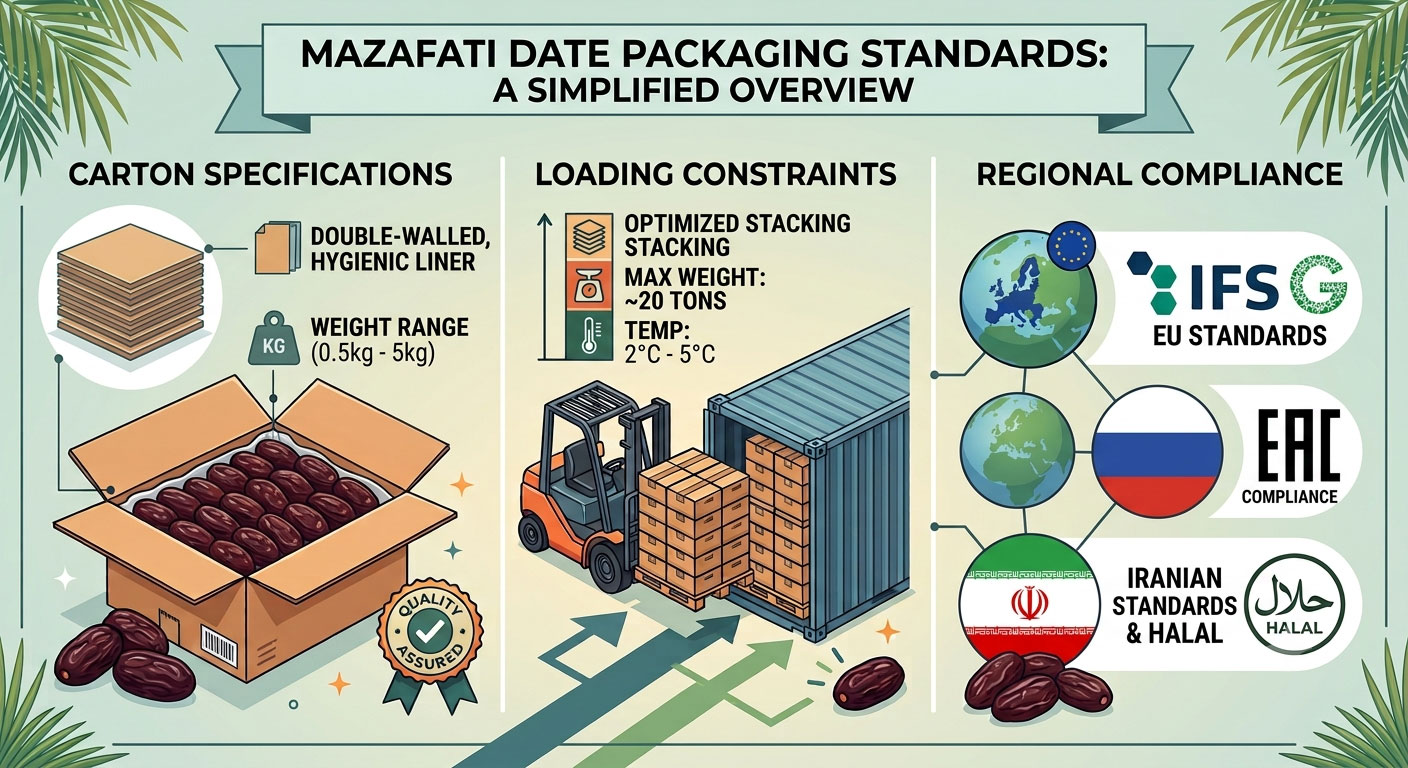
More than 50% of Mazafati production sells as fresh Rutab. This moisture content makes it highly volatile. Transporting Grade A Mazafati requires an unbroken cold chain set strictly between -2°C and 0°C. Importers must secure refrigerated (reefer) containers from Bandar Abbas to their destination port. A cold-chain failure causes the thick skin to rupture, releasing the syrup and triggering rapid spoilage. Maximum shelf life is under 12 months.
Grade C Mazafati, being drier, occasionally ships in standard dry containers or canvas-covered trucks during cold seasons, but this carries inherent risk.
Piarom’s Operational Advantage
Piarom’s low moisture content eliminates the need for expensive reefer containers. It ships safely in standard dry boxes. While cold transport extends its life, ambient shipping is the industry standard. Shelf life extends safely to 18 months, giving distributors massive flexibility in inventory management.
Packaging Economics
Both varieties utilize the standard 500g plastic or cardboard box, arranged in a 4×4 matrix across three rows. This setup protects the fruit’s shape during transit.
Supply Chain Tip: Piarom’s length (4 to 6 centimeters) and dry texture make it the ideal candidate for custom luxury gift boxes. Our buyers frequently request Piarom stuffed with Iranian pistachios, walnuts, or hazelnuts. The dry nature of the date prevents moisture transfer to the nuts, preserving their crunch.
B2B Pricing Logic: At-Cold-Storage Margins
Pricing determines the target demographic. Based on current local ex-works purchasing rates (at the cold storage door):
- Grade A Mazafati: ~$1.43 per kg
- Grade B Mazafati: ~$0.80 per kg
- Grade A Piarom: ~$4.86 per kg
Piarom costs roughly 3.4 times more than premium Mazafati. This upfront cost deters low-tier buyers. However, for importers targeting the luxury sector, Piarom represents a high-margin opportunity. The lack of cold-chain transport costs offsets a portion of the high procurement price.
[CRITICAL INSIGHT] The Hidden Liability of 5kg Bulk Rutab Mazafati
Many new importers attempt to maximize container volume by ordering high-moisture Rutab Mazafati in 5kg bulk cartons. We strongly advise against this.
While Grade B and Grade C (drier) Mazafati can survive 5kg bulk packaging, placing Grade A or high-syrup Rutab in bulk cartons creates a high-risk scenario. The weight of the dates crushes the bottom layers. Combined with the slightest temperature fluctuation during transit, this pressure causes the skins to burst. The resulting syrup pooling accelerates bacterial growth and guarantees shipment rejection at customs or by the final distributor. Never sacrifice packaging structure to save space on high-moisture dates.
FAQ: B2B Import & Logistics Questions
- What is the shelf life difference between Mazafati and Piarom?
- Stored correctly, Mazafati has a maximum shelf life of under 12 months. Piarom extends to under 18 months due to its dry composition.
- Do I need a reefer container (refrigerated) for Piarom dates?
- No. Piarom’s low moisture level allows for safe transport in dry containers, heavily reducing your freight costs. Reefers are only required for Mazafati (-2°C to 0°C).
- How do I verify Grade A Mazafati from Grade B upon arrival?
- Inspect the skin. Grade A Mazafati has smooth, glossy skin. If the date presents parallel wrinkles and the flesh feels soft when lightly squeezed, you have received Grade B stock.