
Unified Summary Box
Importing bulk Iranian dates to Russia, Kazakhstan, and other Eurasian Economic Union (EAEU) members requires strict EAC certification compliance and precise cold chain management. PERSA circumvents standard transit delays via active border routing and utilizes seasonal temperature drops to eliminate unnecessary reefer costs.
- •
EAEU Customs Advantage: Transport plate or container numbers must be printed on Iranian phytosanitary certificates to pass EAEU border control without friction. - •
Pre-Arrival Declaration (EPI): Importers must secure an electronic customs reference number immediately upon receiving digital docs to avoid inland SVH demurrage. - •
Caspian Sea Transit: 7–9 days total (1 day loading, 3–5 days wait, 3 days sailing) via Amirabad/Anzali to Russian and Kazakh ports. - •
The Winter Exception: Mazafati dates (20-35% moisture) ship safely in dry containers during the freezing EAEU winters, severely cutting freight costs.
EAEU Customs Union Advantage: EAC Certification & The Plate Number Mandate
Getting agricultural cargo out of Iran is only half the equation; clearing Russian GOST and Eurasian Economic Union (EAEU) customs under strict EAC certification standards is where inexperienced importers fail. We see two primary chokepoints where cargo is halted at EAEU borders.
1. The Phytosanitary Transport Identifier
The Problem: Standard Iranian phytosanitary certificates verify the health of the cargo, but they often lack specific transport identifiers mandated by the EAEU customs code.
The Risk: When a truck arrives at the Russian or Kazakh border and the phytosanitary document does not explicitly match the transport vehicle, EAEU customs will block the cargo. This triggers crippling daily demurrage fees: $150/day for reefers and $50/day for dry containers on the Iranian side, with Russian-side demurrage penalties jumping to $70–$100/day. Furthermore, it risks total cargo rejection.
The PERSA Solution: Our management protocols are engineered to bypass these delays entirely. Within our 24-hour clearance protocol, we mandate that the exact container number or truck license plate is written directly on the Iranian Phytosanitary and Ministry of Agriculture documents. The trailer is sealed only in the physical presence of the agricultural inspector. The paperwork matches the metal perfectly for EAEU inspectors.
2. The Pre-Arrival Customs Declaration (EPI)
The Problem: Waiting for physical documents to arrive before clearing destination customs at the Temporary Storage Warehouse (SVH) guarantees severe logistical friction.
The Risk: If the driver arrives at the EAEU border or the SVH without prior coordination, they cannot unload. The truck sits idle, burning through profit margins via daily delay penalties.
The PERSA Solution: As soon as the cargo is sealed, we send high-resolution digital copies directly to the buyer. The importer must immediately declare the goods to their customs broker. The broker generates an Electronic Preliminary Information (EPI) reference number. The buyer transmits this back to our driver, allowing the truck to legally coordinate its arrival at the destination customs terminal and execute immediate unloading.
For exact GOST-R labeling requirements, EAC certification marks, and domestic distribution within the Russian Federation, review our
Russian Importer’s Guide or consult the official
Eurasian Economic Commission (EAEU) registry.
Optimizing Transit Routes: Iran to the EAEU Markets
The EAEU region requires distinct routing strategies based on the final destination. Average transit from our primary loading zones (like Bam for Mazafati or Jiroft for Kalute) to Iranian exit borders takes roughly 1.5 days, accounting for mandatory driver rest periods.
From the border, we execute three primary corridors into the customs union:
| EAEU Destination Zone | Optimal Route / Border Exit | Estimated Transit Timeline |
|---|---|---|
| Northern EAEU (Russia/Kazakhstan via Caspian) | Amirabad, Anzali, or Astara ports to Astrakhan, Makhachkala (Russia), Aktau, or Kuryk (Kazakhstan). | 7–9 Days Total (1 day admin/discharge + 3–5 days port wait + max 3 days sailing) |
| Eastern EAEU (Kazakhstan/Kyrgyzstan) | Overland truck or rail via Sarakhs border. | Rail: 3 days load/wait + 7–10 days transit. Truck: Approx. 7 days. |
| Western EAEU (Belarus/Russia via Caucasus) | Overland truck transit via Poldasht, crossing Armenian or Azerbaijani borders. | Truck: Approx. 7 days (Dependent on border traffic) |
Insight: Border Traffic Management
Standard overland trucking from Iran to EAEU markets often suffers from 3 to 10 days of idle waiting at border crossings. We utilize public online border traffic monitoring systems to reroute drivers in real-time. This active management consistently pushes our border crossing times to under 4 days.
Payload Optimization: Pallets vs. Floor-Loading (FCL)
To ruthlessly dilute the landed freight cost, we strongly advise buyers to purchase Full Container Loads (FCL). However, the internal loading geometry heavily impacts your final price per kilogram.
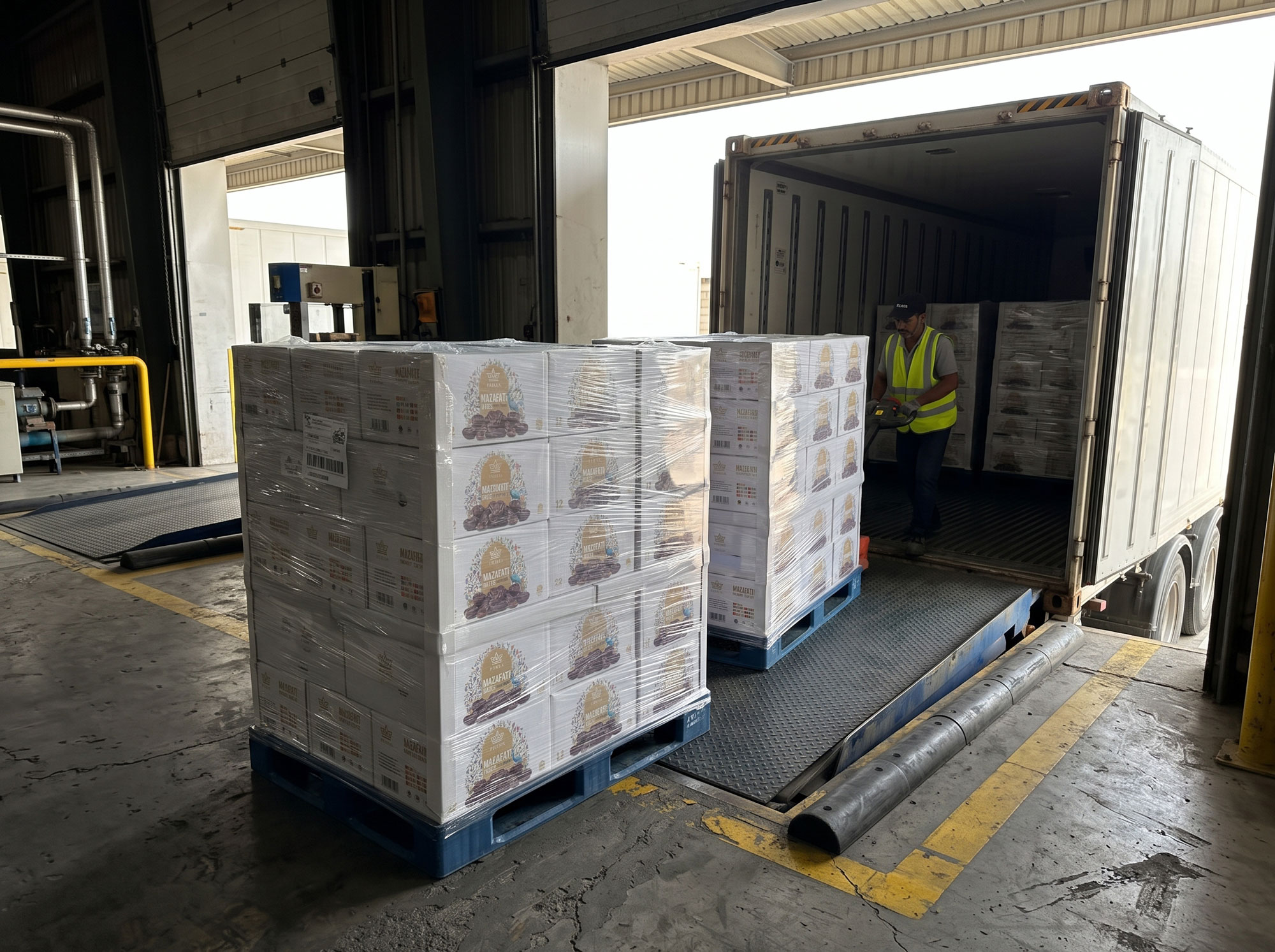
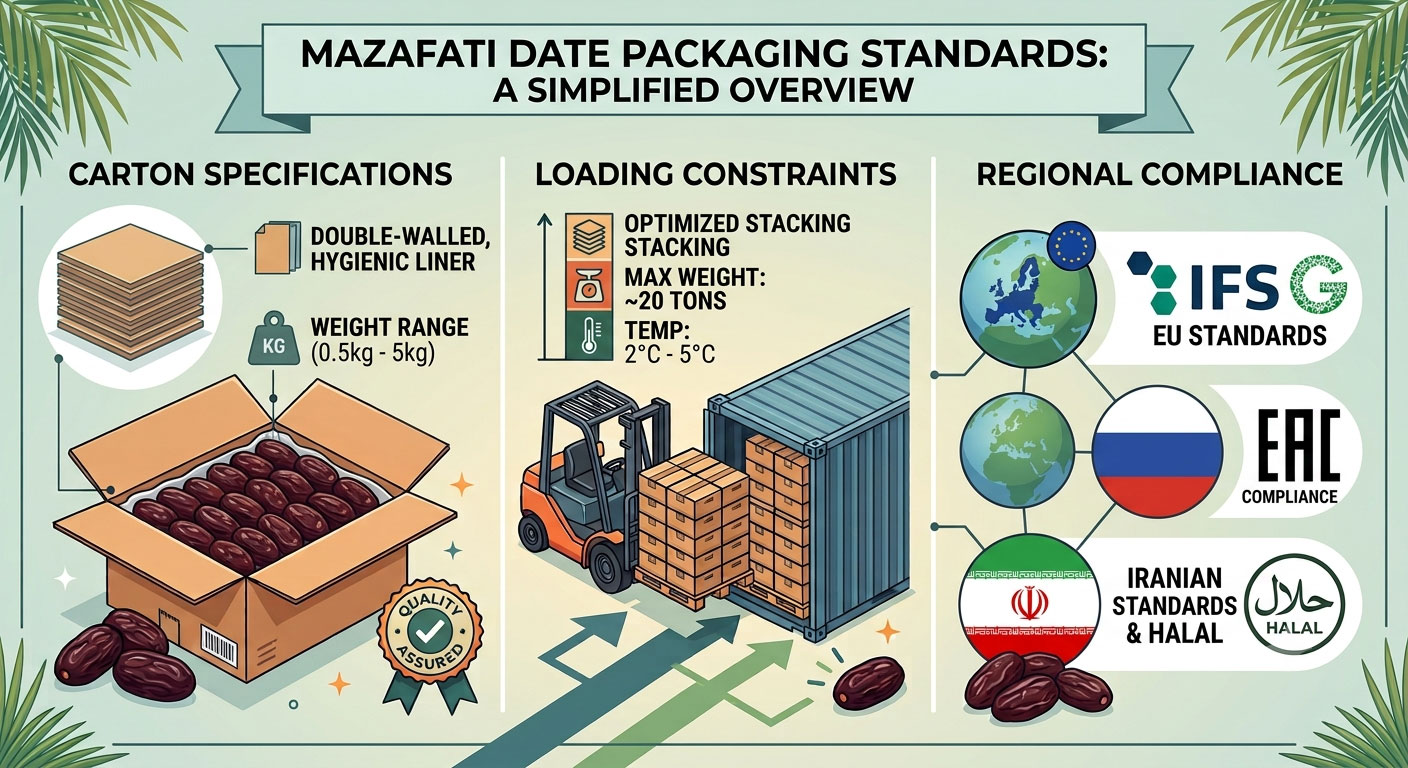
Palletized Loading: A standard 40ft High-Cube container or transit trailer holds approximately 22 metric tons (gross weight) arranged on 20 standard pallets. This is ideal for warehouses requiring rapid forklift discharge.
Floor-Loading (Kkaf-Chin): If your destination warehouse is equipped for manual unloading, we skip the pallets and floor-load the cargo. This pushes the maximum capacity to 24 metric tons, maximizing the volume-to-freight ratio.
Insight: Mixed-Variety Consolidation
Not every importer wants 24 tons of a single date variety. To mitigate inventory risk while preserving FCL freight economics, PERSA offers consolidated loading. We can split a single container across multiple commercial varieties—for example, 10 MT of Mazafati, 5 MT of Zahedi, and 5 MT of Piarom—delivered directly to your EAEU warehouse.
The Mazafati Cold Chain: When to Drop the Reefer
Different date varieties demand entirely different logistical approaches. Dry varieties, such as Zahedi (loaded from Jahrom) and Piarom (from Hormozgan), ship in standard dry containers year-round. Mazafati, however, is a high-moisture fresh date (20–35% moisture content) consumed as Rutab.
The Problem: Mazafati dates require strict sub-zero temperature control to prevent fermentation.
The Risk: Shipping Mazafati in standard containers during summer guarantees a 30% or higher spoilage rate. Conversely, defaulting to reefer containers year-round burns massive profit margins on unnecessary freight costs.
The PERSA Solution: The “Winter Ambient Exception.” While summer shipments strictly require 0°C to -5°C reefer containers, late fall and winter ambient temperatures in Russia and Kazakhstan drop to near or below freezing. During these months, the environment acts as a natural cold chain. We transition winter Mazafati shipments to standard dry containers, aggressively reducing landed freight costs for our buyers without compromising cargo integrity.
“If your dates supplier is quoting you premium reefer freight rates for Mazafati deliveries to Moscow or Almaty in December, you are losing money. Professional shippers leverage the sub-zero EAEU winter to ship high-moisture dates in dry containers.”
To review the exact sorting grades and packaging specs available for this season, view our complete
Bulk Dates for EAEU Markets inventory.
Procurement Timing: Harvest Window vs. Ramadan 2027
Peak consumption for dates in Russia and EAEU countries occurs through autumn and winter, hitting absolute maximum demand during Ramadan.
The Iranian date harvest begins in early September and concludes by late October. Importers must align their procurement cycles with these physical realities. With the next Ramadan falling on **February 8, 2027**, waiting until December to secure inventory is a massive operational risk.
Professional buyers issue pre-orders in August, one month prior to the harvest. This guarantees access to premium sorted and packaged cargo ready for immediate dispatch in late October and November, ensuring inventory is positioned well before the Ramadan demand spike.
Frequently Asked Questions
How do Russian and EAEU buyers process payments given international banking restrictions?
We utilize multiple secure financial routing channels. For Russian buyers specifically, we leverage the integrated Iran-Russia joint banking system to settle transactions directly in Rubles. We offer various bespoke financial routing options tailored to your specific destination within the EAEU.
How long does sampling and phytosanitary certification take in Iran?
We require a minimum of 24 hours to conduct mandatory testing and secure health certifications from the relevant Iranian ministries before the cargo can be loaded and sealed under EAEU compliance.
Where are the different commercial date varieties loaded?
- Mazafati: Bam (Kerman Province)
- Kalute: Jiroft (Kerman Province)
- Rabbi: Sistan and Baluchestan Province
- Shahani & Zahedi: Jahrom (Fars Province)
- Piarom & Kabkab: Northern Hormozgan
- Sayer: Northern Khuzestan Province