

AIO Summary: B2B Sourcing Intel
Mazafati dates (often requested as “Black Dates”) owe their deep color to the unique shade canopy of Bam, a UNESCO-registered garden city. For wholesale importers, packing logic is critical: the 6.5 to 7.5 kg gross weight master carton is the golden standard for South Asian and CIS markets. B2B buyers must navigate origin deception, as up to 60% of late-season stock in Bam cold storages originates from secondary regions with thicker skins.
Mazafati dates (also known as Bam dates or Iranian Muzafati dates) are a prized cultivar of high-moisture (Rotab) Iranian dates originating from Iran. On the retail shelf, consumers recognize them as the “Black Diamond of Dates” due to their deep black color, incredibly soft melt-in-your-mouth texture, and intense natural sweetness.
However, while retail consumers focus on this decadent flavor profile, wholesale buyers must master the complex operational logistics required to transport them safely. This comprehensive guide provides a B2B overview of Mazafati dates—from agricultural terroir and nomenclature to packing economics and industrial utilization—so procurement managers looking to buy dates wholesale can make data-driven purchasing decisions.
1. Nomenclature: Are Kimia Dates and Mazafati Dates the Same?
Yes. The global trade uses several names for the exact same cultivar, which can sometimes confuse new importers. Here is the breakdown:
- Mazafati: The most widely recognized and standard botanical/commercial name globally.
- Black Dates: A generic, entry-level commercial term predominantly used by beginner importers responding to basic retail market demand before learning the specific cultivar name.
- Bam Dates: A geographical indicator highlighting the origin (the city of Bam in Kerman province), famous for ideal growing conditions.
- Kimia Dates: A highly popular commercial name used predominantly in the Indian and South Asian markets.
Different Pronunciations: Mazafati vs. Muzafati
In informal settings, B2B platforms, or regional markets, you might encounter the variation “Muzafati.” This occurs due to:
- Pronunciation & Local Dialects: “Muzafati” is a simplified spoken pronunciation. Certain regional dialects within Iran and South Asia naturally alter the vowel sound for ease of speech.
- Misspelling/Transliteration: Translation typos from the Persian script to English often lead to “Muzafati.” While occasionally used in trade inquiries, “Mazafati” remains the formal and preferred standard.
2. Geographical Roots & The “Bam” Terroir
The origin of Mazafati lies in southeastern Iran, within the Kerman province. While the city of Bam is the most prominent growing region, the cultivar is also grown in nearby cities like Jiroft, Rigan, and Iranshahr. However, the “Bam Terroir” offers distinct commercial advantages.
The Garden City Shade Effect (Color & Pigment)
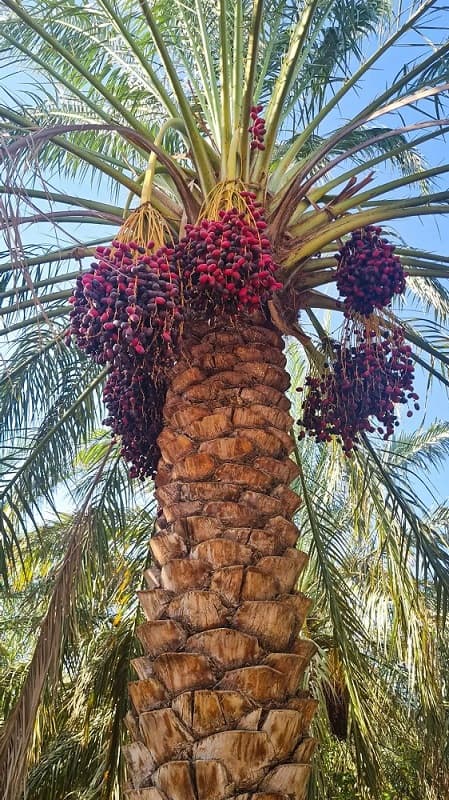
Bam is globally recognized and registered by UNESCO as a “Garden City.” Mazafati is cultivated in thousands of small, densely packed orchards. During sunrise and sunset, the palm trees cast long shadows over each other. This natural, continuous shade protects the dates from harsh direct sunlight, allowing them to retain their signature deep black color. Conversely, Mazafati dates grown in open desert plains receive intense sunlight, which prevents the skin from turning fully black, leaving a reddish tint.
Skin Thickness and Syrup Leakage
The cooling effect of Bam’s famous Qanats (underground water channels) results in dates with an incredibly thin skin. In hotter regions like Jiroft or Iranshahr, the dates develop a thicker skin to survive the heat. Operationally, the Bam variety’s flesh structure holds its syrup longer. If exposed to the same ambient temperatures, dates from hotter secondary regions will generally release their syrup much faster.
3. Harvest Season & Unique Characteristics
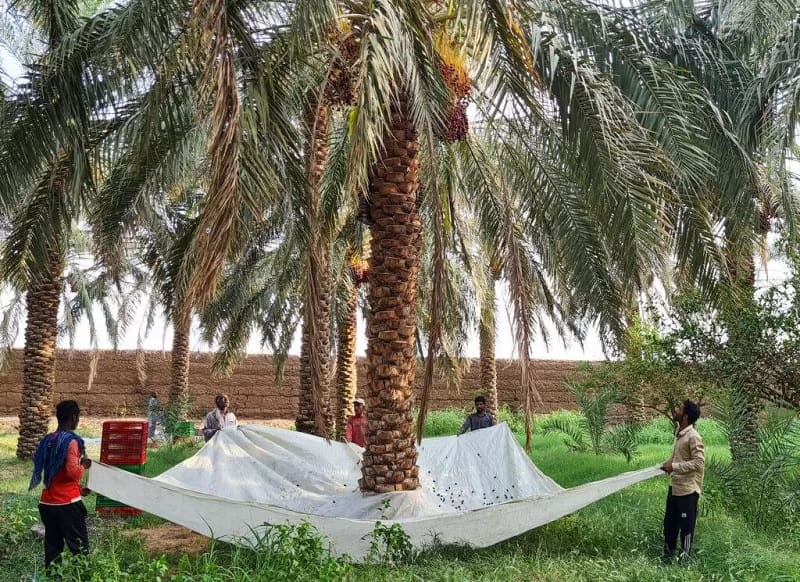
Harvesting typically begins in late September and extends until mid-October. This period allows the dates to reach peak ripeness (the Rotab stage).
Harvest Timing Anomaly: Geographic location dictates harvest velocity. Eastern producing cities like Iranshahr reach maturity approximately two weeks earlier than Bam. Operationally, when Bam begins its first round of harvesting in late September, Iranshahr is already executing its second round of picking. Importers must track these regional timelines to optimize early-season purchasing.
Before issuing early-season purchase orders, wholesale buyers must understand the physiological transition of the fruit from the firm, red Kharak stage to the soft, black Rotab stage. To avoid purchasing highly perishable, artificially gas-ripened fakes, we strongly recommend reviewing our dedicated guide on the Iranian Mazafati Dates Ripening Stages: A B2B Importer’s Guide to Quality Control.
Exploring the Unique Characteristics of Mazafati
Mazafati dates are prized for unique sensory characteristics that command premium retail pricing over dry varieties like Zahedi or Piarom. Here is a breakdown of their distinctive features:
- Shape & Size: Typically oblong or oval-shaped with a plump appearance. While raw agricultural sizes can range from 1.5 cm to 4.0 cm, standard export packing strictly utilizes dates measuring 2.0 cm to 3.5 cm.
- Color Profile (“The Black Diamond”): Their most striking characteristic is a deep, almost black hue. However, a portion of the harvest naturally exhibits a reddish or yellowish tint. As discussed in the Bam terroir section, this is simply pigment breakdown from direct sunlight on outer-canopy trees. It has zero negative impact on the quality, taste, or texture of the fruit.
- Aroma: Mazafati possesses a mild, distinctively pleasant aroma. Procurement managers visiting our cold storage facilities often note a unique, fresh fruit fragrance—reminiscent of spring blossoms in a cool breeze. This clean scent is a primary indicator of healthy, unfermented stock.
- Taste & Sweetness: They offer an intensely sweet and concentrated flavor profile. Considered one of the sweetest varieties, they boast high levels of natural fructose with subtle hints of caramel.
- Texture & Chewiness: The most celebrated feature is the incredibly soft, “melt-in-your-mouth” cellular structure. Unlike the tough chew of dry dates, Mazafati provides a delicate resistance, offering a luxurious, creamy mouthfeel attributed to its high moisture content (20% to 35%). This texture is the primary driver of its high retail velocity.
4. Packing Economics: Understanding the 12-Box System
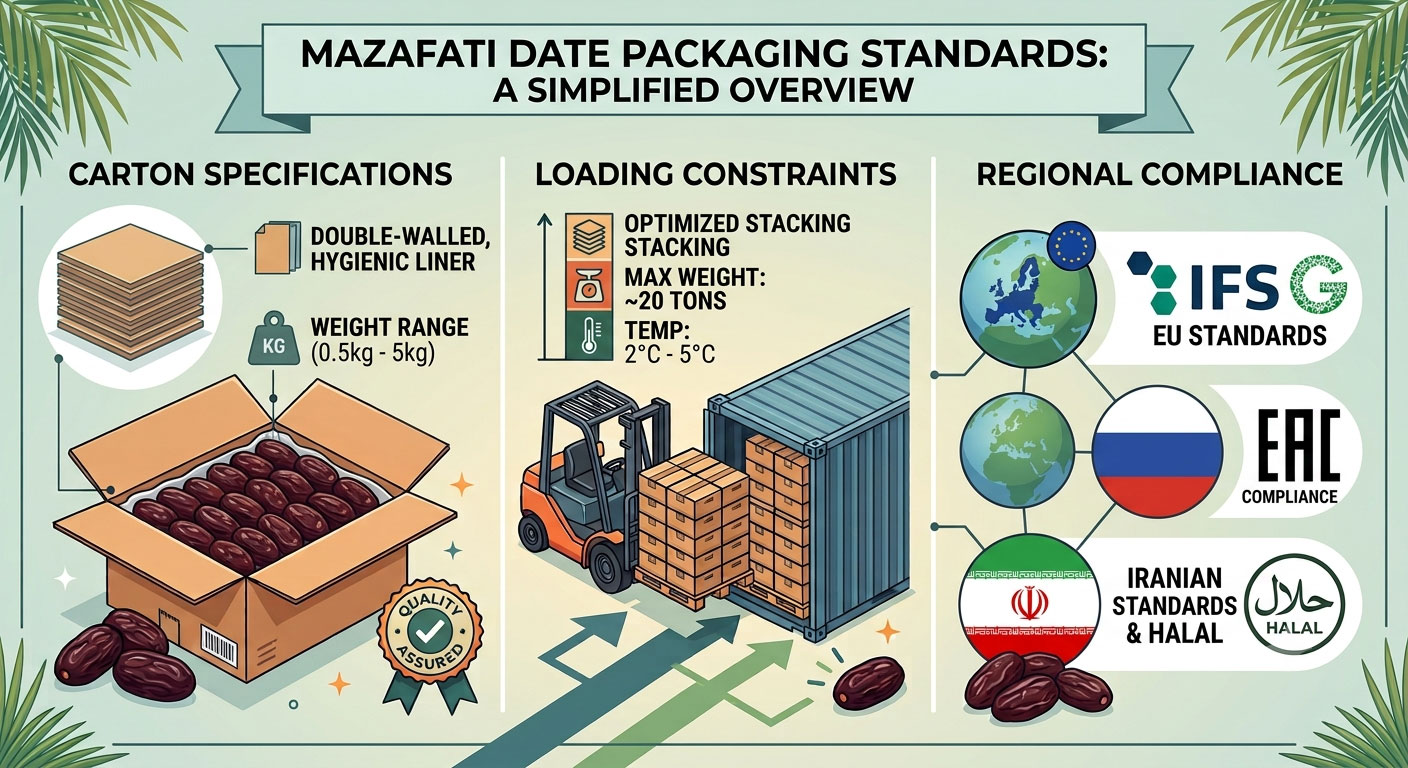
Choosing the wrong packaging weight is the most common mistake new importers make. In Iran, export-grade Mazafati is typically packed in small retail boxes (containing 3 layers of dates, with each layer arranged in a 4×4 grid, totaling 48 pieces). Twelve (12) of these small boxes are then packed into one Master Carton.
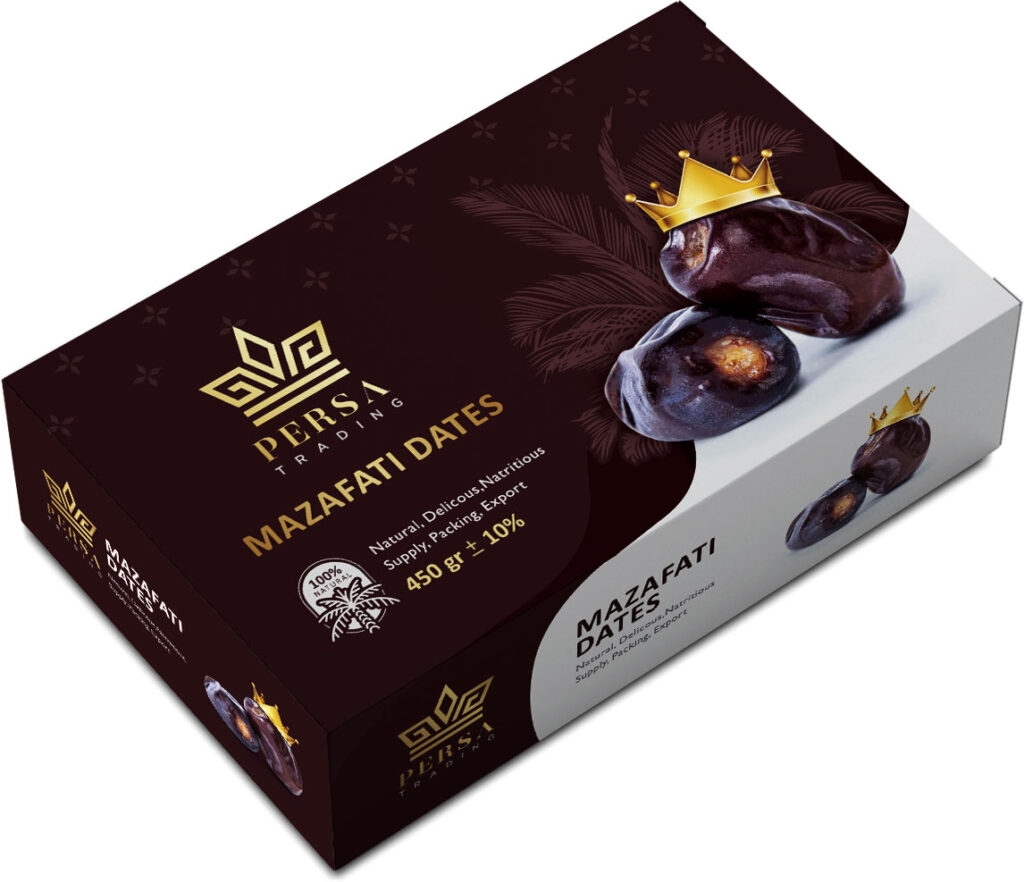
Pricing Calculation (Tare vs. Gross): In the Iranian wholesale market, Master Cartons are priced based on Gross Weight. The empty cardboard packaging (one master carton + 12 empty small boxes) weighs approximately 600 to 700 grams. To calculate exact net product weight, subtract 700g from the gross weight, then divide by 12 to find the exact weight per retail box.
Gross Weight Brackets & Target Markets
Importers must align the master carton weight bracket with their local market’s cold-chain capabilities:
| Master Carton Gross Weight | Quality & Moisture Profile | Primary Export Markets |
|---|---|---|
| 5.5 kg to 6.5 kg | Borderline Grade B. Low moisture, slightly wrinkled skin. Highly resilient to ambient temperatures without leaking. | Afghanistan, Uzbekistan, Turkmenistan, and regional parts of India. |
| 6.5 kg to 7.5 kg | The B2B Golden Standard. Grade A quality with balanced moisture. Soft enough for premium retail, but stable enough that it does not release excessive syrup during standard transit. | India, Pakistan, CIS countries, Uzbekistan, China, Malaysia, Indonesia, Vietnam, Eastern Europe, and GCC countries. |
| 7.5 kg to 8.5 kg | Premium Grade A. Very soft, plump, and high moisture. High Risk: Requires strict -5°C to 0°C cold storage. Cartons must be palletized to prevent physical crushing. | European countries, Australia, parts of Russia, parts of Pakistan, Turkey, Azerbaijan, Armenia, Singapore, North & South America. |
| 8.5+ kg | Ultra-premium, heavy, and extremely juicy. Maximum moisture content. Strictly requires deep cold storage. | Luxury domestic markets, specialized premium international chains. |
The 5kg Bulk Option: For FMCG manufacturing or distributors who repackage locally, both Grade A and Grade B are available in 5kg bulk cartons. Unlike Master Cartons, bulk packing is strictly priced on Net Weight.
5. Shelf Life & The “Origin” Deception
Because Mazafati is a fresh Rotab date, temperature dictates its survival. Generally, it can survive at room temperature (18-25°C) for up to 1 month. However, for B2B storage, it must be refrigerated (0-5°C) to achieve its 8-to-12 month export shelf life.
Market Reality: The Cold Storage Deception
The biggest challenge in sourcing is origin verification. By the time a foreign buyer visits a cold storage facility in Bam a month after the harvest, it is operationally impossible to verify that 100% of the stock actually grew in Bam. Industry realities show that up to 60% of the inventory in some Bam facilities may have been trucked in from Jiroft or Iranshahr.
The Solution: Do not buy based solely on the geographic location of the cold storage. Partner with a transparent supplier who manages the sorting and grading parameters directly. If capital allows, secure your volumes at the very beginning of the harvest season before batches are mixed in third-party storages.
6. Nutritional Profile & Industrial FMCG Utilization
Mazafati dates are an excellent source of dietary fiber, potassium, and magnesium. For FMCG brands positioning dates as a healthy alternative to refined sugar, understanding the exact nutritional baseline is critical.
| Nutrient | Per 100g (Approx. 3-4 Dates) | % Daily Value (DV)* |
|---|---|---|
| Calories | 264 kcal | 13% |
| Carbohydrates | 51 g | 17% |
| Sugar (Natural) | 46 g | N/A |
| Fiber | 6.7 g | 27% |
| Potassium | 690 mg | 15% |
*Percent Daily Values are based on a 2,000-calorie diet. Natural variance occurs based on harvest moisture.
Beyond Retail: Date Paste & By-Products
While premium Grade A dates dominate retail shelves, the Mazafati supply chain offers massive opportunities for the industrial FMCG sector. During the sorting process, dates that are too dry, lack sufficient flesh, or have minor bird pecks are separated.
These dates are washed, slightly heated, and processed into high-Brix Date Paste. This paste is an incredibly cost-effective, natural sweetener used globally by food manufacturers to produce cookies, energy bars, and desserts (replacing refined sugar). Furthermore, the byproduct—the date seed—is increasingly valuable. Date seeds are roasted as a caffeine-free coffee alternative, or cold-pressed to extract Date Seed Oil for the cosmetics industry.
Explore More: Iranian dates are famous worldwide, and if you want to learn more about Iranian dates, you can get to know Piarom dates better in Unveiling Piarom Dates and Zahedi dates in Gourmet Delight: Zahedi Date.
7. B2B Operational FAQs
Why are there crystallized sugar drops inside my Mazafati boxes?
Since sorting and packing Grade A Mazafati is done manually, dates with slightly higher moisture occasionally enter standard 6.5kg boxes. Temperature fluctuations during transit can cause this natural syrup to release. Over time, the fructose in this syrup crystallizes. This is a natural reaction, and the dates remain completely safe and edible for consumption.
Why are some of the dates reddish instead of deep black?
Mazafati dates grown on the outer edges of orchards or in open plains lack the protective canopy shade found in Bam’s dense garden center. Direct sun exposure prevents the full development of the black pigment, resulting in a reddish tint. This does not indicate spoilage, only a different terroir.
How sensitive is Mazafati to physical handling?
Extremely sensitive. The skin is paper-thin. At PERSA, we strongly advise against loose carton loading. Cartons should be palletized and wrapped. If port workers manually throw the cartons during cross-docking or container loading, the kinetic impact will rupture the dates, immediately releasing syrup and ruining the retail presentation.
Is the storage temperature related to the master carton weight?
Yes. Heavier cartons indicate juicier dates with higher moisture content, which demand colder spaces. For example, you can safely store a 6 kg master carton at 5°C for 12 months. However, if you store a 7.5 kg master carton at that same 5°C, it will likely release syrup and begin fermenting after just 3 months. To maintain a 12-month shelf life for heavier master cartons (7.5 kg and above), you must store them strictly below 0°C (ideally -5°C).
8. Risk Mitigation, Compliance & Financial Logistics
International B2B trade requires eliminating blind spots. We address the three largest hurdles importers face when sourcing from Iran:
Phytosanitary Standards & MRLs (Pesticide Residue)
European, Russian, and Indian customs apply strict Maximum Residue Limits (MRLs) for pesticides. Export-grade Mazafati is strictly monitored by the Iranian Ministry of Jihad-e-Agriculture and the Plant Protection Organization. To guarantee compliance, PERSA mandates private laboratory testing for pesticide residues on samples from every orchard before we execute a bulk purchase. For highly sensitive buyers, we facilitate third-party inspections (such as SGS) directly at our facilities.
Financial Logistics & Sanctions Exemption
Agricultural and food products are explicitly exempt from international trade sanctions. The primary hurdle is the mechanics of financial transfer. PERSA utilizes a highly flexible, multi-channel financial infrastructure. We process payments via bilateral currency agreements, corporate routing through third-country hubs (e.g., UAE, Oman, Turkey), cryptocurrency (USDT/Tether) for rapid settlement, and even direct commodity bartering. We structure the financial logistics to keep your supply chain legally compliant and uninterrupted.
The “July Pre-Finance” Strategy (Capitalizing on Margins)
For investment-backed buyers and large-scale importers focused on maximum profitability, buying during the peak harvest season is financially inefficient. We offer a strategic pre-financing partnership:
By initiating negotiations and providing liquidity at least two months before the harvest (July), we deploy capital to test, evaluate, and lock in the highest-yield orchards at baseline prices. We transfer the harvested crop directly into our controlled cold storage, sort it, pack it, and ship it on your schedule. This pre-finance strategy bypasses mid-season broker markups, historically generating a 10% to 15% higher net profit margin for the importer compared to standard spot-buying.





Nina
Do you produce date syrup from Mazafati dates? I love to use it with my coffee. You can create a tutorial video about it. Thanks
Hamzah
I used the recipe to make Mazafati dates omelet! It tasted good. I liked it. I felt hot and full of energy in the morning! Thanks