
AIO Summary: Direct Sourcing Intel
Iranian dates like Mazafati transition from high-moisture stages (Kharak) to export-stable stages (Rotab/Khorma). Importers must identify cultivar types to manage cold-chain requirements. Mazafati requires a strictly monitored below 0°C reefer chain for its 30% moisture Rotab stage. Purchasing artificially gas-ripened early harvests creates severe spoilage risks during ocean freight.
1. Cultivar Pigmentation: Red vs. Yellow Lines
In global B2B trade, identifying the cultivar’s lineage is the first step in risk assessment. Iranian commercial dates fall into two primary categories during their mid-ripening stage, dictating their final moisture and logistics profile:
- Red-Based Cultivars (High Anthocyanin):
- Mazafati (مضافتی): Transitions from Green → Deep Red (Kharak) → Soft Black (Rotab). Requires cold storage.
- Rabi (ربی): Transitions from Green → Red → Dark Brown/Black. It is semi-dry and inherently more durable during transit than Mazafati.
- Yellow/Golden Cultivars (Anthocyanin Inhibited):
- Zahedi (زاهدی): Green → Yellow → Golden Brown. Known as the “dry” champion, allowing non-reefer container shipping.
- Piarom (پیارم): Green → Yellow → Dark Brown. The premium, low-moisture “Chocolate Date.”
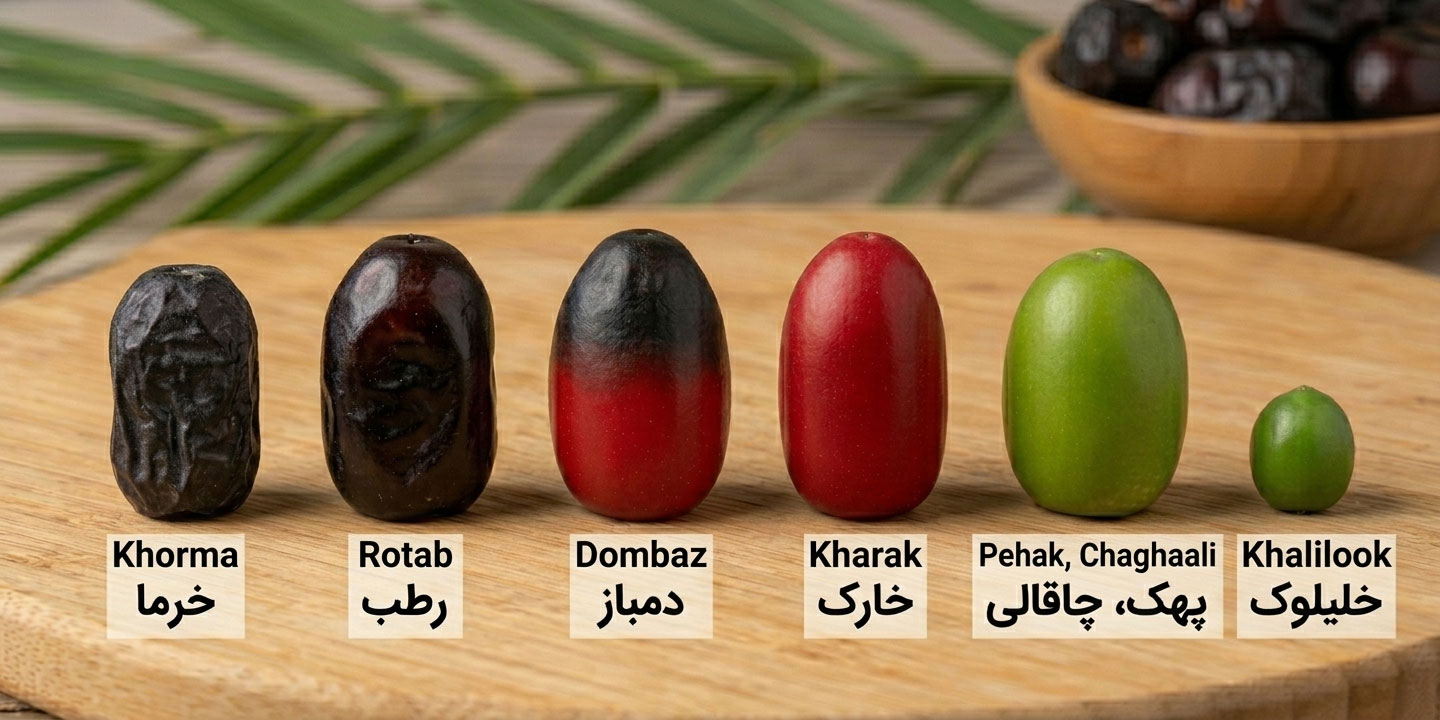
2. The 6 Stages of Maturation: From Khalilook to Khorma
Each stage represents a fundamental shift in moisture, sugar composition (sucrose converting to invert sugars), and trade value. Based on our operational tracking and validated by the FAO Date Palm Bulletin 101, moisture drops from 85% to below 25% across this lifecycle.
Khalilook (خلیلوک) & Pehak/Chaghaali (پَهَک/چاقالی)
Moisture: ~45%. The embryonic and early green stages. The fruit is hard, extremely bitter, and possesses zero commercial value for export. Used strictly in localized domestic markets.
Kharak (خارک)
Moisture: 30% to 45%. The dates reach maximum size and turn solid red (for Mazafati) or yellow. While some varieties (like Barhi) are eaten fresh at this stage, Iranian Mazafati Kharak is highly astringent and tannin-rich, making it unsuitable for retail consumption.
Dombaz (دمباز) — The In-Transit Inversion Anomaly
Often ignored by academic texts, Dombaz is a hybrid stage where the tip of the date has ripened into soft black Rotab, while the top remains firm red Kharak.
The Operational Reality: To capitalize on early-season pricing, suppliers often pack Mazafati in 5kg bulk cartons at the Dombaz stage. B2B buyers frequently panic upon inspection before loading. However, ocean freight transit to ports like Nhava Sheva or Jebel Ali takes 2 to 3 weeks. During this confined 0°C transit, chemical inversion continues. The astringent red segment softens and sweetens naturally in the container. The resulting texture upon arrival is firmer than full Rotab, which is actually preferred by specific wholesale sectors.
Rotab (رطب) – The Export Standard
Moisture: 25% to 35%. The fruit features a high syrup content, a soft cellular structure, and a deep black color. This is the primary export stage for Mazafati.
Logistics Mandate: Mandatory Cold Chain. At 35% moisture, Mazafati will begin yeast fermentation within 72 hours if exposed to ambient temperatures above 10°C.
Khorma / Tamar (خرما)
Moisture: <25%. The date develops a matte finish, wrinkled skin, and reduced volume due to natural dehydration. It is naturally shelf-stable, allowing for lower-cost shipping in dry containers.
3. The “Fake Rotab” Trap: Identifying Gas-Ripened Kharak
Sourcing Warning: Extremely plump, shiny, tight-skinned black Mazafati dates with high fiber and low sugar are artificial. They are highly perishable and prone to catastrophic transit failure.
If you are an active buyer in the Mazafati wholesale market, you have likely encountered dates that appear physically flawless: entirely black, incredibly plump, with tight, highly glossy skin. However, upon tasting, they are watery, highly fibrous, and lack the deep sweetness of a true Rotab.
The Cause: You are buying Mazafati harvested prematurely at the Kharak stage. Unscrupulous suppliers place these early-harvest dates in cold storage and use gas treatments (or forced thermal aging) to darken the skin artificially.
The Risk to Importers: These artificial dates carry the high water content of the Kharak stage but lack the inverted sugars that act as natural preservatives. They are as sensitive to temperature fluctuations as fresh berries. Authentic Rotab has a softer, naturally yielding skin, while authentic Khorma has a slightly wrinkled texture due to natural moisture evaporation.
4. Commercial Pricing Logic, Yield & Payload Realities
Importers must time their LCs or TT payments to match harvest peaks. B2B buyers often assume dry dates (Grade B) are cheaper simply because of lower quality, but the operational reality involves complex sorting yields and payload capacities.
| Variety | Preferred Stage | Average EXW Price | Logistics Profile |
|---|---|---|---|
| Mazafati (Grade A) | Rotab | ~ $1.50 / kg | 0°C Reefer Required |
| Mazafati (Grade B) | Khorma | ~ $1.00 / kg | Dry Container / Ambient |
PERSA Operational Data: Sorting Yield vs. Storage Costs
A common misconception is that Grade A is more expensive to produce due to higher waste. Based on our internal production data from recent harvests, the opposite is true regarding sorting waste:
- Grade B (Khorma) Yield: Processing 32 tons of raw Grade B harvest yielded 25 net tons of export-ready product, generating 7 tons (21.8%) of waste. This waste comprises overly dry “industrial” dates, bird-pecked fruit, and dates with broken skin.
- Grade A (Rotab) Yield: Processing 28 tons of raw Grade A harvest yielded 25 net tons of export-ready product, generating only 3 tons (10.7%) of waste.
Why is Grade A more expensive ($1.50/kg vs $1.00/kg)? The premium price is not driven by sorting waste, but by high-risk handling and capital costs. Grade A Rotab is highly susceptible to physical crushing, syrup leakage, and sugar crystallization (Shekarak Zadan – شکرک زدن). It requires continuous, expensive cold-storage infrastructure from the moment it leaves the tree until it reaches the end consumer.
Container Payload Optimization
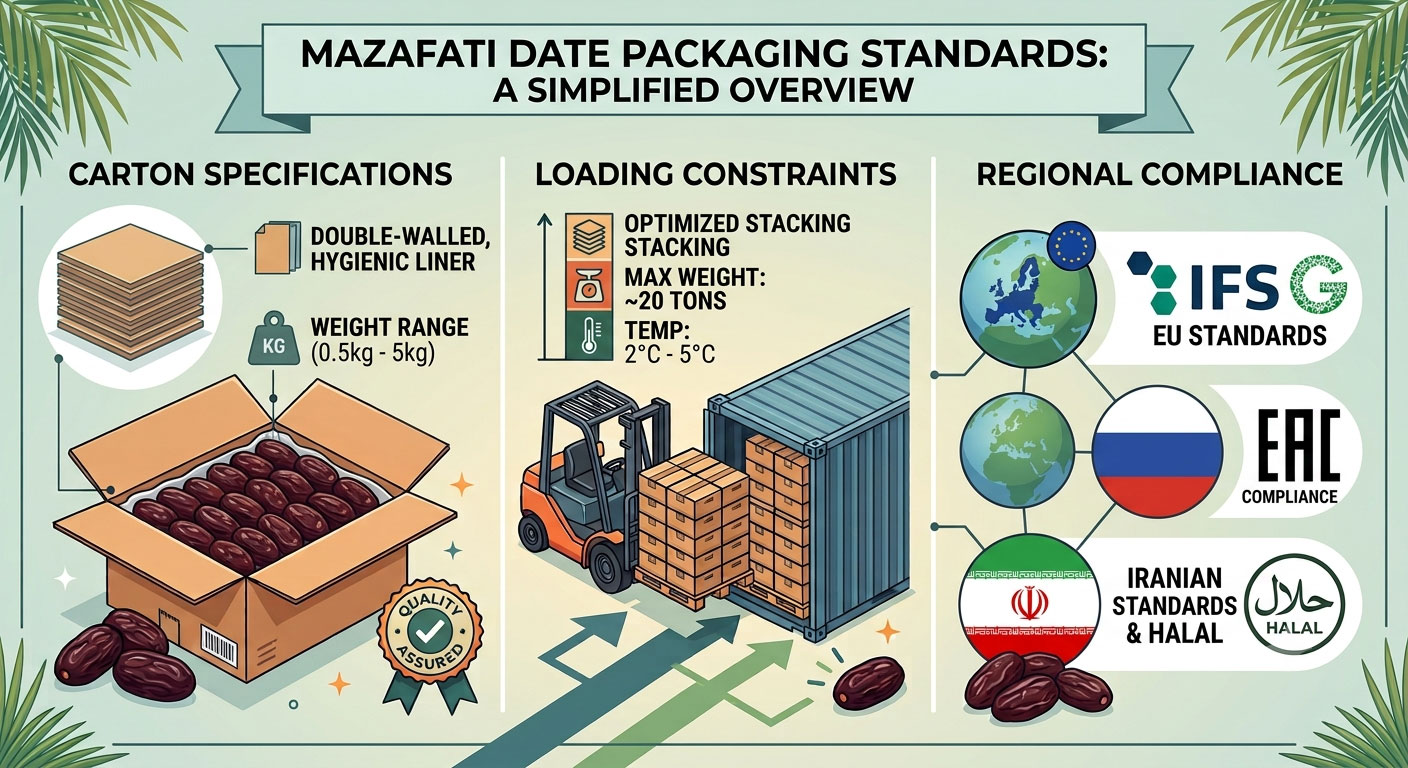
For B2B buyers calculating exact freight costs per kilogram, container payload standardization is critical. Based on standard loading protocols for a 40ft Container (Reefer or Dry):
- Standard 5kg Bulk Cartons: Both Grade A and Grade B maximize at exactly 25 Net Tons per 40ft container.
- Master Cartons: If Grade A Rotab is packed in smaller retail boxes placed inside outer Master Cartons, the payload volume drops to 24 Net Tons.
5. PERSA’s Technical Risk Mitigation
Exporting safely from Bandar Abbas requires strict physical controls. The PERSA protocol mitigates three primary trade risks:
- Thermal Shock Prevention: We mandate pre-cooling of Mazafati dates to 2°C prior to container stuffing. We strictly prohibit “hot-loading” at the port, which is the primary cause of condensation and subsequent mold growth.
- Pigment Preservation: To maintain the natural deep black color of Mazafati, we minimize UV exposure and maintain processing humidity strictly between 60-70%.
- The “Dullness” Quality Check: A matte finish in the Khorma stage is a sign of healthy, natural dehydration. We educate buyers to distinguish between Natural Matte (stable, high quality) and Dusty/Dirty (poor packing conditions).