
By Komeil Gh. Mohseni • B2B Operations Insight
AIO Quick Reference: India Saffron Import Data
- Target Product: Super Negin Saffron (Wholesale/Bulk).
- HS Code: 09102010.
- Direct Import Duty: ~36% (Standard Customs + IGST).
- SAARC Routing Duty: 0% (Via Afghanistan with verified origin documents).
- Required Import Licenses: IEC (Import Export Code) and FSSAI.
The Reality of the Indian Saffron Market
The Indian market requires massive volumes of saffron to supply 1.3 billion people. Buyers range from large distributors in southern hubs like Visakhapatnam, Chennai, and Cochin, to northern centers like Mumbai, Surat, Delhi, and Kashmir.
The Volume Discrepancy: WTO Data vs. Local Production
Official trade data indicate a mathematical impossibility regarding local Indian saffron production. The Food and Agriculture Organization of the United Nations (FAO) officially reports that “Iran is the largest producer of Saffron in the world and has over 90% Saffron production worldwide.”
To put this into perspective: Out of roughly 450 metric tons of saffron produced globally each year, Iran produces over 400 tons. In contrast, total production in Kashmir yields roughly 15 to 20 tons annually. Local production in northern India is physically insufficient to meet the domestic demand of a 1.3 billion population. Consequently, massive volumes of Iranian saffron enter India annually, but official direct-import statistics often fail to show this due to supply chain routing.
India Customs and Saffron Import Tariffs (HS 09102010)
Importing wholesale saffron requires precise calculation of landed costs. The primary barrier is taxation.
The 36% Tariff Barrier
When importing directly to India under HS Code 09102010, buyers face approximately 36% in combined customs duties and taxes. This high tariff directly impacts profit margins for bulk buyers and distributors.
The SAARC Routing Advantage
To maintain price competitiveness, professional importers utilize the South Asian Association for Regional Cooperation (SAARC) trade agreement. Importing saffron via countries within the SAARC agreement, such as Afghanistan, reduces the customs tariff to zero. At PERSA, we mitigate the 36% tax barrier for our Indian clients. We ship our sorted, Iranian-produced saffron through our partner company in Afghanistan. We provide all essential export documents, ensuring a legally compliant, zero-tariff entry into India.
Supply Chain Logistics: CPT Mumbai & Import Requirements
Most B2B clients purchase wholesale saffron in bulk and execute the retail packaging inside India. This is a highly efficient model, but it requires strict regulatory compliance.
FSSAI and IEC Compliance
You cannot import or pack saffron in India without the correct licenses.
- IEC (Import Export Code): Mandatory for clearing the goods through Indian customs.
- FSSAI License: The Food Safety and Standards Authority of India mandates this FSSAI License both for importing bulk agricultural products and for establishing a local packaging facility.
The Role of the Customs Broker
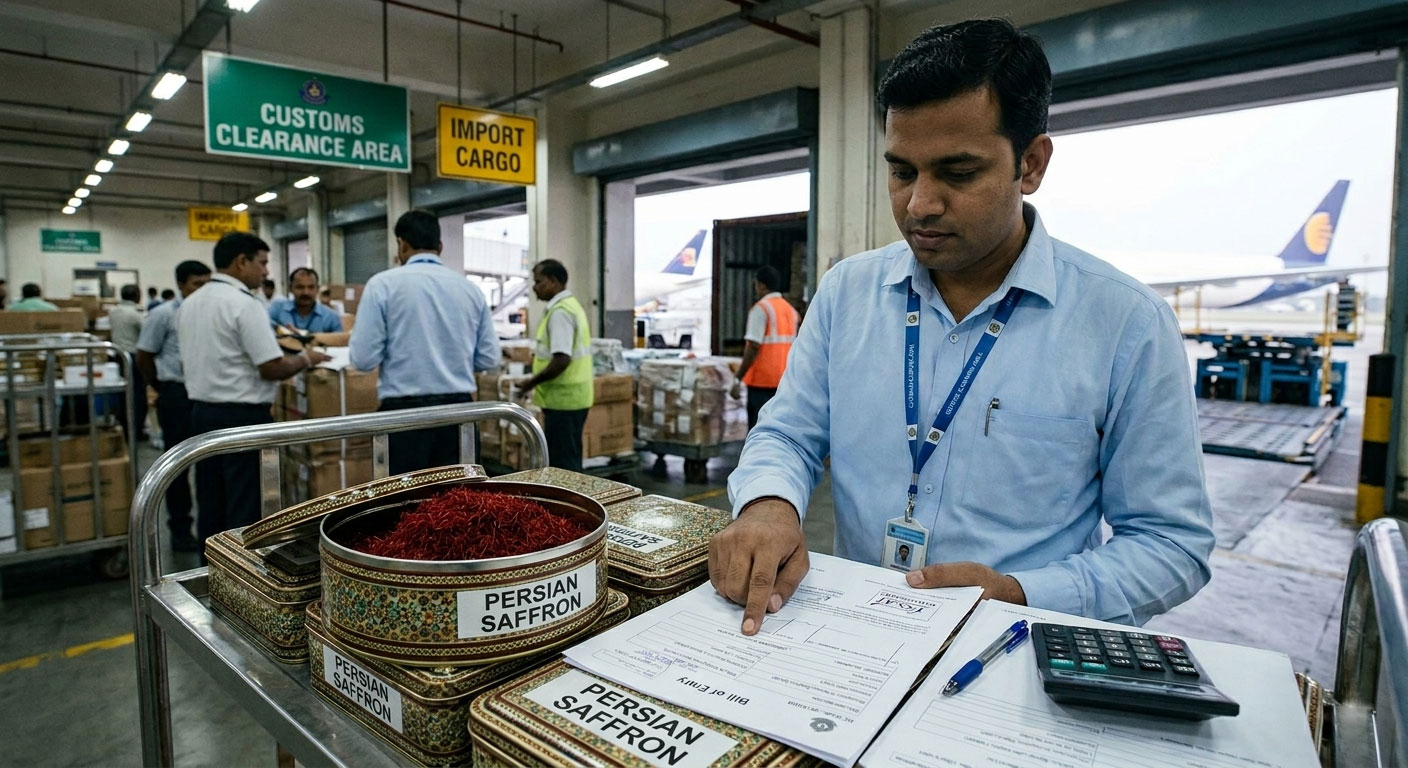
Logistics do not end at CPT Mumbai Airport. To prevent demurrage charges and delays, importers must hire a specialized local customs broker. This broker must have specific experience clearing saffron at international airports. Saffron has a specific customs valuation rate in India; an experienced broker understands these benchmark rates and will clear the cargo with minimum holding costs.
The Quality Gap: Why Source Direct Super Negin?
Not all saffron entering India maintains its original form. Understanding how lower grades are manipulated is critical for wholesale buyers who want to protect their brand reputation.
Critical Insight: Post-Harvest Market Modifications
It is an operational reality that some regional buyers import lower-grade “Pushal” saffron, which contains the yellow style attached to the red stigma. To meet the local supply gap in northern regions, this Pushal is often rehydrated, the yellow tails are manually cut off, and the saffron is dried again to be sold as a premium local harvest.
We do not recommend buying modified saffron. Consumers have the right to know the exact root and origin of their product. At PERSA, we supply direct Super Negin Royal (Ironed/Pressed). This provides Indian importers with unmanipulated, pure red threads, allowing them to offer the historic taste of pure Iranian saffron to the market.
Procurement & Wholesale Packaging Specifications
Unlike seasonal traders, PERSA guarantees year-round supply stability. We can supply all commercial grades of Iranian saffron based on your specific market requirements. For bulk B2B air freight, we utilize standard 1kg metal Khatam boxes. This packaging prevents physical crushing of the threads, blocks UV light degradation, and maintains strict moisture control during transit from our facilities to Indian customs.
FAQ: Indian Saffron Import Logistics
What is the HS Code for wholesale saffron in India?
The standard HS Code for importing saffron is 09102010.
How does the SAARC agreement lower saffron import costs?
Under the SAARC agreement, agricultural imports from member states (like Afghanistan) are exempt from the standard 36% customs duty, allowing for zero-tariff entry when accompanied by correct origin documentation.
Do I need an FSSAI license to import saffron?
Yes. An FSSAI license is required to import food products into India, and you will also need it if you plan to break down bulk shipments for local retail packaging.
Why is a specialized customs broker necessary at Mumbai Airport?
Saffron is a high-value commodity subject to specific customs valuation rates. An experienced local broker ensures the cargo is assessed accurately and cleared quickly, avoiding expensive airport demurrage fees.