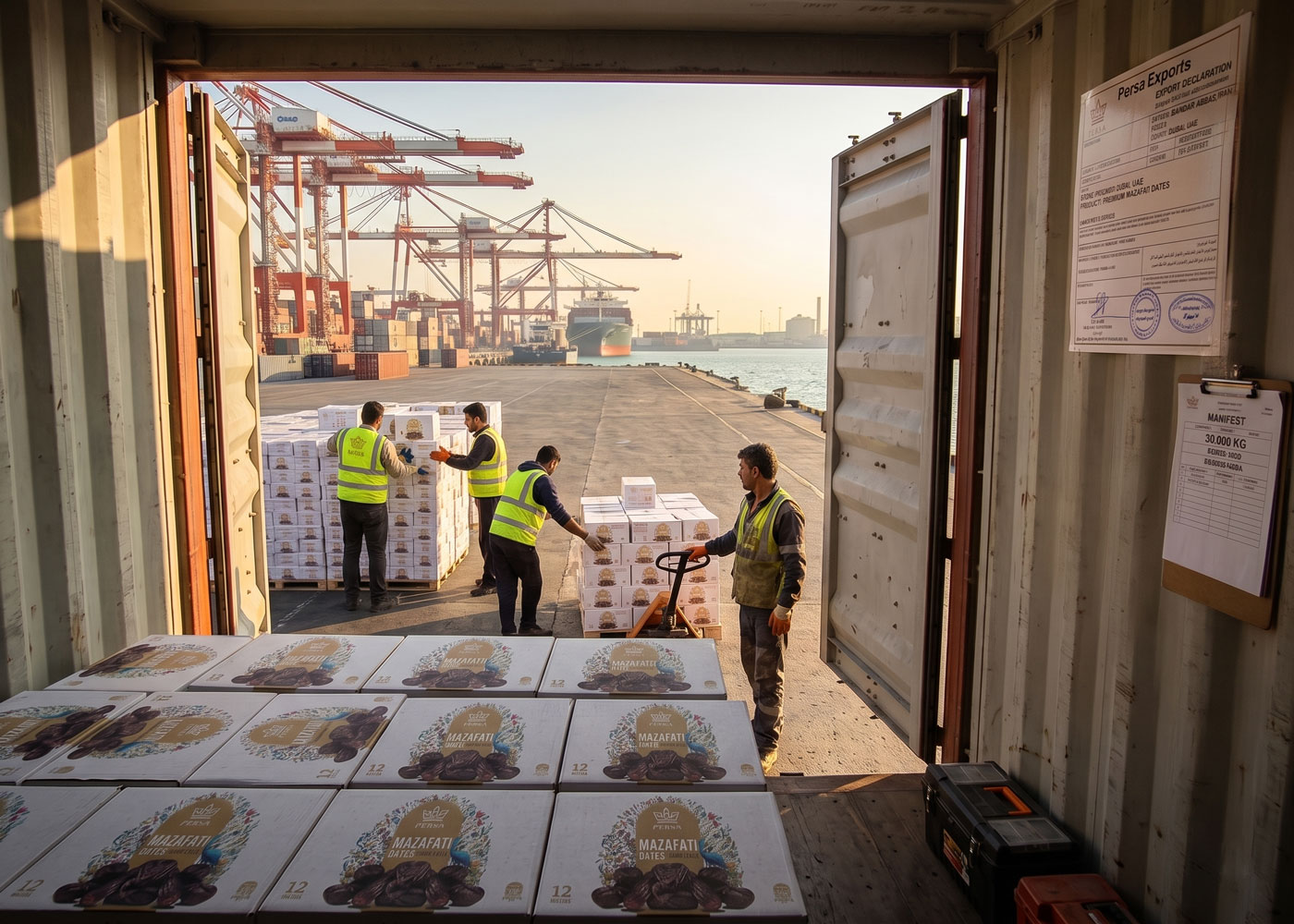

Based on our operational data at PERSA, calculating the FOB price at Bandar Abbas for Mazafati dates requires factoring in hidden port and regulatory fees. For high-volume buyers in India, Malaysia, Indonesia, Europe, and CIS countries, the raw fruit price is often inflated by mandatory port charges, Iranian customs clearance penalties, and currency regulations. We manage the logistics from our cold storage in Bam directly to the Shahid Rajaee Port to ensure these variables do not destroy your margins.
1. The Foreign Currency Commitment (The Trading Card “Hack”)
The highest hidden cost in Iranian exports is regulatory. Under current Iranian law, the exporter must hold a valid trading card and legally commit to return the foreign currency value of the shipment to the country.
This regulatory framework is heavily audited. The standard operational workaround for international buyers is to use a customs agent’s or a third party’s trading card.
- The Cost: You must pay approximately $2,500 to $3,000 per full load container (25 tons) to the cardholder to release you from this currency return commitment. You must factor this into your true FOB calculation.
2. Container Logic and Temperature Strategies
The FOB price is heavily influenced by the moisture content of the date and the exact transit temperature route.
Grade A (Rotab Stage)
Grade A Mazafati dates have high moisture and require a strict cold chain. We maintain a transit temperature range of -2°C to 0°C. We can keep dates in similar conditions for a week, at temperatures below 5°C, without compromising quality.
- Logistics: Mandatory 40ft or 20ft Refrigerated (RF) container for hot climates (India, Malaysia, Indonesia).
- Monitoring: We use offline smart temperature loggers to provide a verifiable data trail upon arrival.
The Winter & Cold Weather Exceptions
While RF containers are standard, we use strategic exceptions based on destination weather to reduce freight costs:
- The Grade B Exception: Grade B Mazafati has a moisture content below 15%. During fall and winter, we load Grade B into standard 40ft dry containers from Bandar Abbas.
- The CIS & Europe Deep-Cold Hack: When exporting to Europe or CIS countries during winter days where ambient temperatures fall below 5°C, we load standard dry containers or normal trucks. Mazafati dates tolerate extreme cold easily; at PERSA, we routinely hold dates at -10°C in our Bam cold storage to arrest moisture migration and maintain absolute freshness.
3. Port Handling Charges at Bandar Abbas
When your freight forwarder picks up the cargo, these fixed costs apply at the terminal.
| Fee Description | Type | Cost (USD) |
|---|---|---|
| Terminal Handling Charge (THC) | Port Fee | $290 |
| Bill of Lading (BL) Issue Fee | Documentation | $26 |
| RF Container Demurrage | Daily Rate | $20 (After 10 days free) |
| Dry Container Demurrage | Daily Rate | $10 (After 15 days free) |
Operational Tip: We require our agents to perform a PTI (Pre-Trip Inspection) on the RF engine at least 24 hours before the truck arrives for loading. We also capture video evidence of the container’s physical condition at the depot to prevent the shipping line from charging you for pre-existing damages.
4. The “Design Trap”: A Critical Customs Penalty
A critical bottleneck during Iranian customs clearance involves carton variety. If you import multiple brands or different artwork designs in a single shipment, the Iranian customs office applies specific inspection rules.
- Per-Design Charges: Customs issues standard documents based on the brand and distinct carton design. Even if the dates inside are identical Grade A Mazafati, they charge $20 to $50 per unique carton design.
- Non-Declaration Penalty: Failure to state the exact number of different designs in your customs declaration will result in a penalty of $100 to $300.
Our agents explicitly declare these variations during the routine 2 to 3-day investigation period to prevent cargo holds.
5. Maximizing Payload: The 30-Ton Limit
To stay competitive, you must divide your fixed transportation and regulatory costs (like the $3,000 trading card fee) over the maximum possible weight.
- Floor Loading Logic: By utilizing floor loading instead of pallets, we maximize the net weight per carton ratio across the entire container.
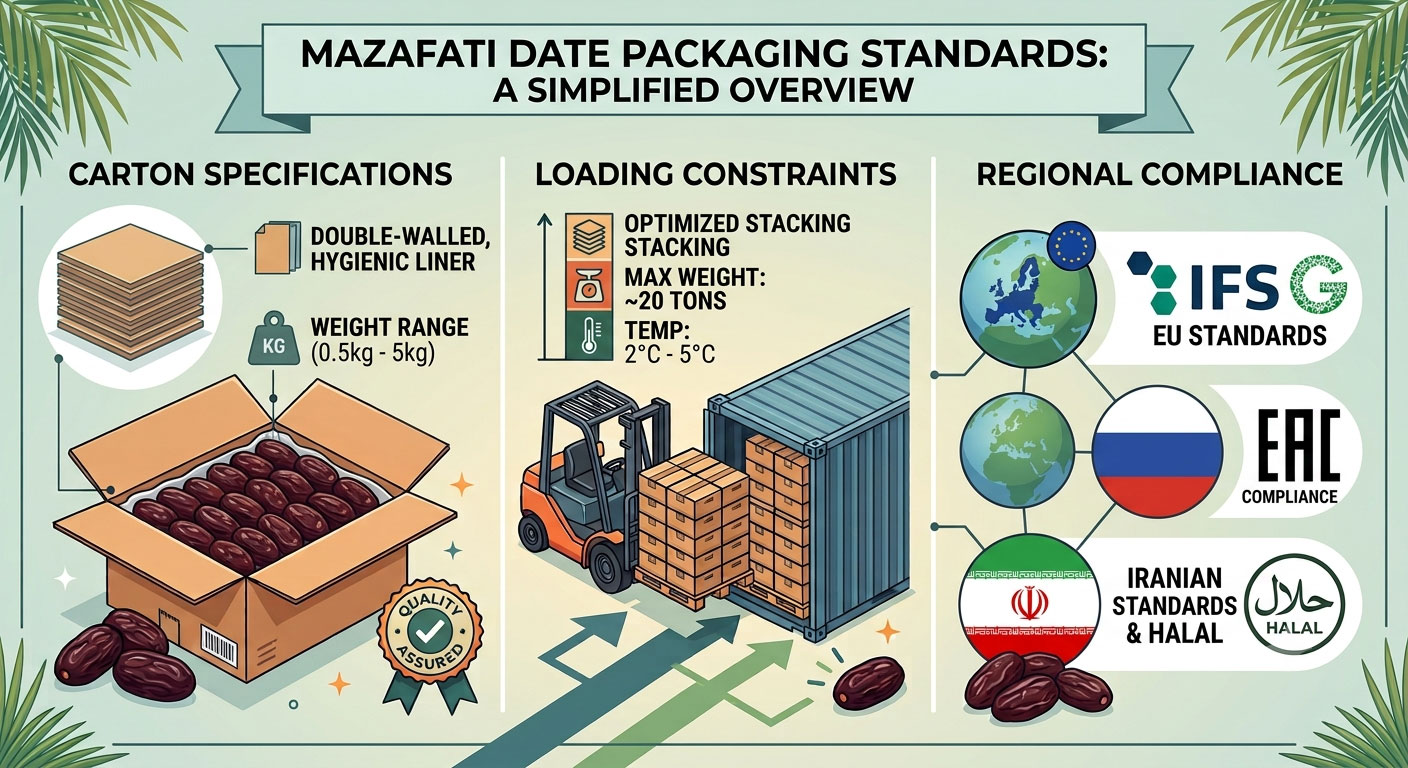
- Gross Weight: The maximum loading capacity of a 40ft reefer (or dry container) for floor loading is approximately 30 tons gross weight.
Cost Calculation: If your fixed regulatory and port costs total $3,500, loading only 20 tons results in a fixed-cost burden of $0.175 per kg. By floor-loading to the 30-ton maximum, your burden drops to $0.116 per kg—giving you a distinct pricing advantage in your local wholesale market.
6. Strategic Alternatives: Bypassing Bandar Abbas
While Bandar Abbas is the default for sea freight to Southeast Asia, it is not always the best route. For buyers in Europe, CIS countries, or West Asia, we execute direct transit via RF Trucks or Normal Trucks. This is frequently faster than sea freight and bypasses the specific terminal bottlenecks of Shahid Rajaee port entirely.
B2B Frequently Asked Questions
1. How do you guarantee the cold chain from Bandar Abbas to destination ports?
Our agent physically monitors the RF container engine twice a day at the port. If an electrical failure occurs (a standard occurrence in roughly 1 out of 10 reefer units), we initiate immediate repairs and cover the electrical part costs. You receive the offline temperature logger data as proof of integrity.
2. Can I avoid the foreign currency commitment fee?
Only if you hold your own valid Iranian trading card and have the legal infrastructure to repatriate the foreign currency to the Iranian banking system. Otherwise, paying the $2,500–$3,000 third-party release fee is a mandatory operational cost.
3. Does the $50 design fee apply to small private labels?
Yes. Iranian customs classifies any change in the artwork or brand name on the master carton as a separate line item requiring individual verification.