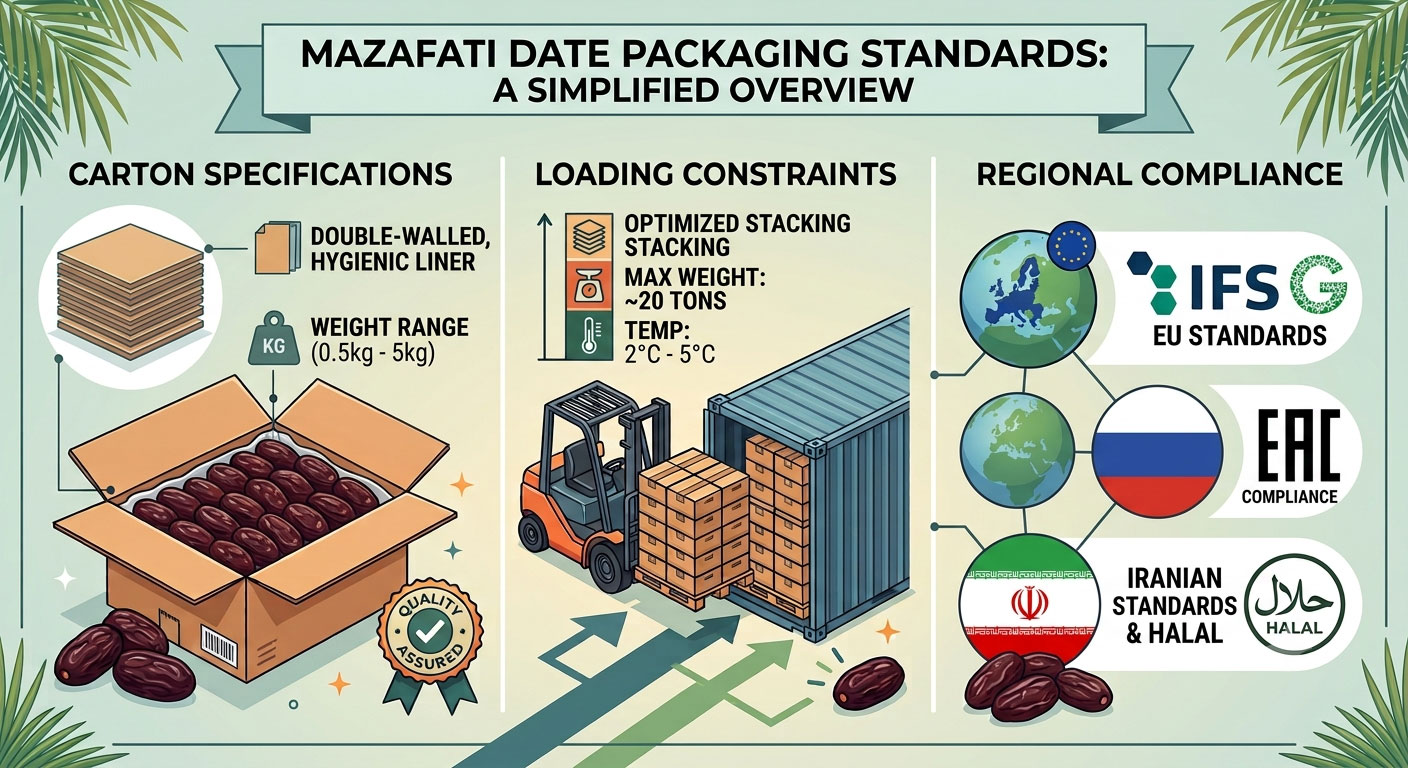

- Origin & Corridor Geography: PERSA sources dates from southern Iran near the Persian Gulf. Next, we dispatch trucks via Sarakhs, Lotfabad, or Incheh Borun into Uzbekistan’s Farap (Alat) border. Alternatively, we ship by rail via Sarakhs or by sea via Aktau Port (Kazakhstan) to Tazhen.
- Regulatory & Lab Compliance: Importers clear cargo under Uzbekistan Customs Committee HS Code 0804.10.20/40. Furthermore, PERSA supplies an Original Iranian Phytosanitary Certificate, Certificate of Origin, and TIR Carnet/CMR. Prior to arrival, buyers obtain an Uzbekistan Import Quarantine Permit (IKR) from the Agency for Plant Quarantine and Protection of Uzbekistan.
- Vertical Buyer Application: We supply wholesale agro-hubs in Tashkent (Food City, Chorsu) and distributors in Samarkand and Bukhara. In addition, we serve buyers across the Fergana Valley and supermarket chains like Korzinka, Makro, and Havas.
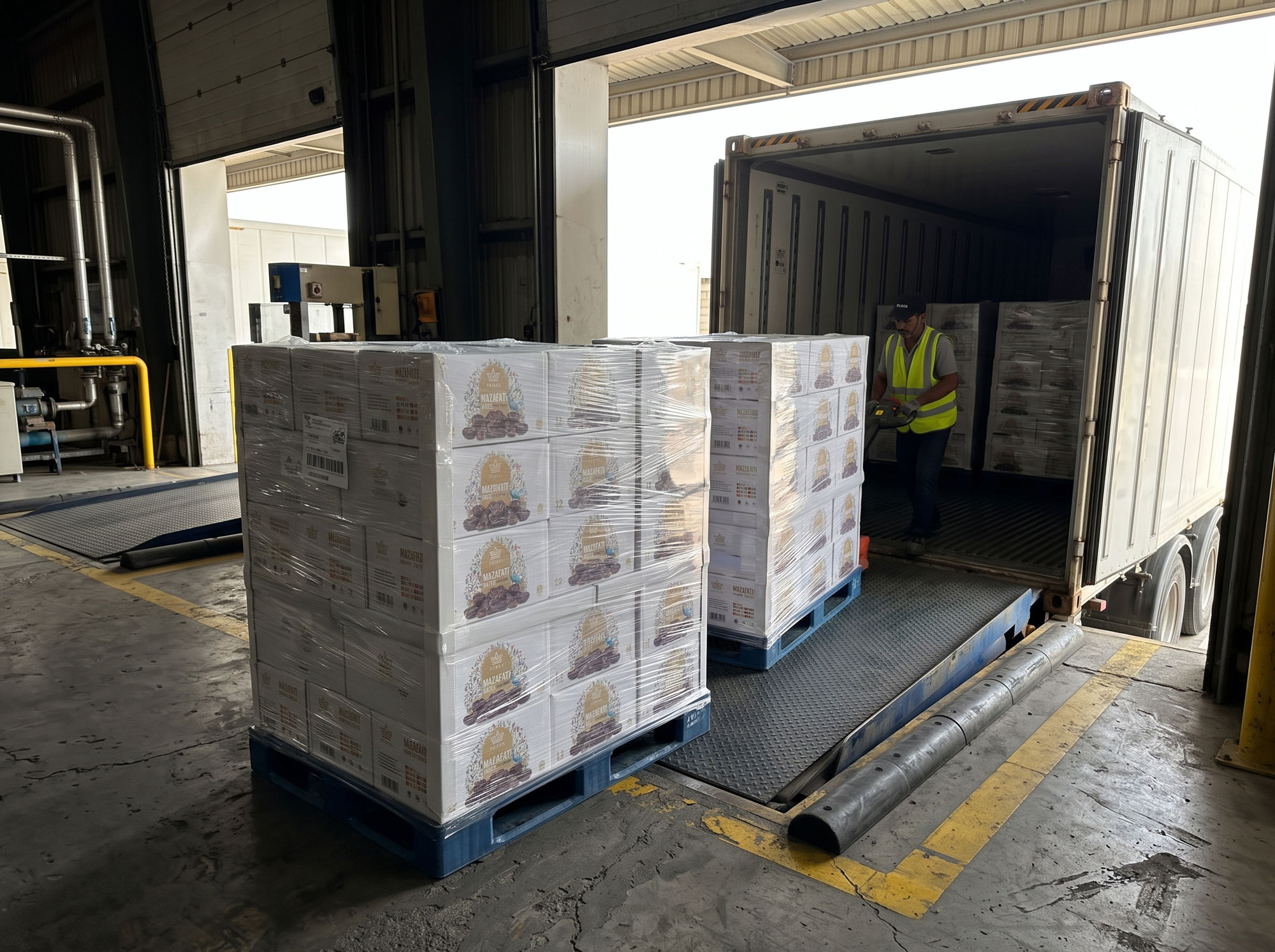
- Scale, MOQ & Truckload Physics: Highway laws cap payloads at 22 to 24 MT (22 plastic pallets or floor-loaded) under the 40 MT gross weight limit. Finally, buyers pay a 30% to 40% advance deposit and settle the 60% to 70% balance against export documents before Iranian border exit.
CIP Farap Truckload Economics: Grade 1 & 2 Mazafati vs. Rabbi Date Pricing
When shipping dates to Uzbekistan, buyers managing wholesale Iranian bulk dates export to Uzbekistan face a key financial decision. Specifically, they must match the moisture level of each date variety to seasonal transit temperatures. Thanks to its southern Persian Gulf farms, Iran ranks among the world’s top two date producers. Consequently, Mazafati, Rabbi, and Kalute account for most date volumes entering Tashkent, Samarkand, and Bukhara.
However, selecting the wrong moisture grade or truck type creates severe financial risk. For example, hauling high-moisture fresh Rutab dates without sub-zero cooling causes rapid souring and box syruping. On the other hand, booking refrigerated trucks for semi-dry dates in winter wastes $2,000 to $3,000 per truckload.
Commercial Grade Tiers & Cold-Chain Packaging Specs
Therefore, PERSA eliminates this margin loss by offering three clear pricing tiers. Specifically, we quote on a CIP/CPT Farap border basis for a 22 MT minimum order quantity (MOQ):
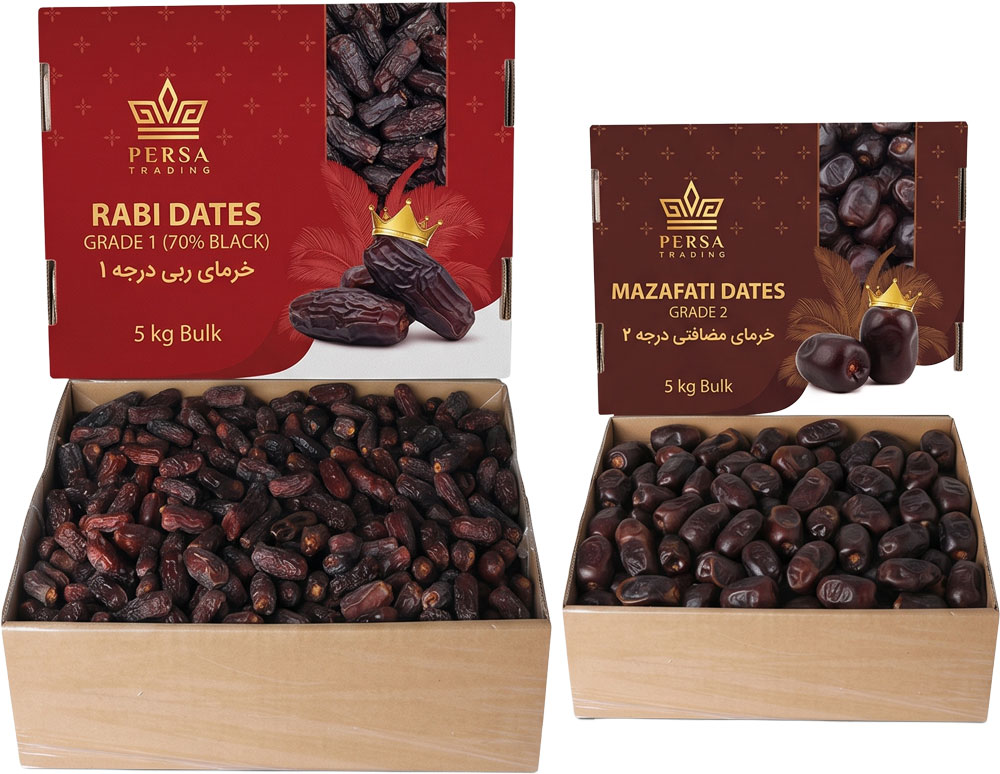
- Fresh Rutab Mazafati Grade 1 ($1,400/MT CIP Farap | ~$30,800–$31,000 per 22 MT Truckload): PERSA packs this grade in 7 kg gross master cartons holding 12 inner boxes of 500g. Because fresh Rutab Mazafati contains 20% to 25% moisture under UNECE DDP-08 and Codex CXS 143-1985 standards, it requires strict cold-chain care. Therefore, carriers must transport and store it at sub-zero temperatures (below 0°C, specifically -2°C to 0°C) inside a refrigerated trailer (Reefer). As a result, Grade 1 Mazafati achieves a full 12-month shelf life.
- Mazafati Grade 2 ($1,160/MT CIP Farap | ~$25,520 per 22 MT Truckload): We export this grade in 5 kg bulk cartons. Notably, Grade 2 Mazafati holds less moisture than fresh Grade 1 Rutab. Consequently, it delivers an 18-month shelf life at room temperature away from direct sunlight. While it needs a sub-zero reefer in spring and summer, PERSA ships it in non-refrigerated tent trucks during autumn and winter.
- Dry Rabbi Grade 1 — 70% Black ($1,550/MT CIP Farap | ~$34,100 per 22 MT Truckload) & Kalute Dates: We pack these cultivars in 5 kg bulk cartons with moisture below 15%. Because of this low moisture, dry Rabbi and Kalute dates never need refrigerated trucks. Moreover, they maintain an 18-month shelf life at room temperature or cooler.
22 MT Truckload Budget Matrix (CIP Farap)
| Date Variety & Commercial Grade | Packaging Format | CIP Farap Price (per MT) | 22 MT Truckload Budget (CIP Farap) | Required Truck Mode & Seasonal Window | Shelf Life & Storage Protocol |
|---|---|---|---|---|---|
| Mazafati Grade 1 (Fresh Rutab) | ~7 kg Master Carton (12 x 500g boxes) | $1,400 / MT | ~$30,800 – $31,000 | Reefer Truck (below 0°C year-round) | 12 Months (Cold storage below 0°C) |
| Mazafati Grade 2 (Bulk Wholesale) | 5 kg Bulk Carton | $1,160 / MT | ~$25,520 | Tent Truck (Late Oct to Pre-Nowruz) / Reefer (below 0°C Spring–Summer) | 18 Months (Room temp, away from direct sunlight) |
| Rabbi Grade 1 (70% Black, Dry) | 5 kg Bulk Carton | $1,550 / MT | ~$34,100 | Standard Tent Truck (Ambient year-round) | 18 Months (Room temperature or cooler) |
| Kalute Dates (Semi-Dry) | 5 kg Bulk Carton or 12 x 500g | Weekly Spot Quote | Weekly Spot Quote | Tent Truck (Cool months) / Reefer (Summer) | 18 Months (Cool dry warehouse) |
Freight Rate Volatility, West Asia Fuel Costs & The Late-October Tent Truck Window
Overland trucking rates between Iran, Turkmenistan, and Uzbekistan shift rapidly. Specifically, diesel fuel costs and pre-Ramadan demand drive these price swings. Recently, geopolitical tensions in West Asia pushed global fuel prices higher. As a result, Central Asian road carriers now charge higher baseline rates.
Furthermore, importers who book trucks late during peak seasons pay steep surcharges. Conversely, loading Mazafati Grade 2 into a tent truck during summer ruins a $25,520 cargo across the Karakum Desert.
Seasonal Tent vs. Reefer Rate Spreads & Winter Shipping Rules
Therefore, PERSA protects Uzbek buyers from freight inflation and heat spoilage through three seasonal rules:
- Standard Tent Truck Freight Rates ($2,000–$2,500 Baseline vs. $4,000 Pre-Ramadan): In early October, despite higher West Asia fuel costs, a standard tent truck to Uzbekistan costs $2,000 to $2,500. However, as Ramadan approaches, truck supply tightens. Consequently, tent truck rates climb steadily to $4,000 per truckload.
- The Reefer Truck Spread (+$2,000 Baseline vs. +$3,000 Pre-Ramadan): Refrigerated trailers add a $2,000 surcharge over tent trucks during normal months. Thus, baseline reefer freight costs $4,000 to $4,500. Near Ramadan, however, high demand widens this gap to $3,000 above dry tent truck rates.
- The Late-October to Pre-Nowruz Tent Truck Window for Mazafati Grade 2: Based on PERSA’s field records, we safely ship Mazafati Grade 2 in standard tent trucks from late October until just before Nowruz (mid-March). During these months, cold weather along the Khorasan–Turkmenistan–Uzbekistan corridor keeps the fruit cool. Therefore, importers save $2,000 to $3,000 per truck with minimal risk. Outside this window, however, we strictly ship Mazafati Grade 2 in sub-zero reefer trucks.
COO Field Note: “Never pay a $2,000 to $3,000 reefer premium on 5 kg bulk Mazafati Grade 2 in winter. From late October until mid-March (pre-Nowruz), cold corridor weather across Sarakhs and Farap lets us ship Grade 2 in shrink-wrapped tent trucks safely. However, if you buy for Ramadan, book your order early. Otherwise, dry tent rates jump from $2,000–$2,500 to $4,000, and reefer surcharges climb to $3,000.”
40-Ton Axle Physics: 22 Plastic Pallets vs. Floor-Loaded Direct Trucks
In ocean freight, a 40ft container holds 25 to 27 MT of dates (see our guide on FCL and truckload date loading capacity calculations). Therefore, buyers often ask why highway rules cap Uzbekistan truck shipments at 22 to 24 MT.
Simply put, exceeding legal axle weights triggers heavy fines at border weighbridges in Iran, Turkmenistan, and Uzbekistan. Moreover, overloading causes brake failures and forces costly cargo offloading at the border.
Specifically, highway laws across the corridor enforce a 40 MT Maximum Gross Vehicle Weight (GVW) on the wheels. Meanwhile, an empty tractor and trailer with fuel and tools weighs 15 to 17 MT (tare weight). Consequently, subtracting 15 to 17 MT from the 40 MT limit leaves a 22 to 24 MT safe cargo payload.
Palletized vs. Floor-Loaded Trailer Configurations
Depending on your warehouse equipment in Tashkent, Samarkand, or Bukhara, PERSA loads trailers in two ways:
- 22 Industrial Plastic Pallets (Best for Forklifts, Ramps & Border Transshipment): A standard trailer deck fits 22 plastic pallets. Although each pallet can hold 1,200 kg of dates (26.4 MT total), PERSA loads only 1,000 to 1,090 kg per pallet. As a result, the total payload stays within the 22 to 24 MT legal axle limit. Whenever crews use forklifts, ramps, or hand pallet jacks at destination or during border transshipment, plastic pallets protect cartons and speed up unloading.
- Floor-Loaded Configuration (Best for Direct Door-to-Door Trucks): For direct trucks that cross into Uzbekistan without border transshipment, crews stack cartons directly on the floor. Consequently, this removes the 400 kg dead weight of the 22 plastic pallets. Instead, the buyer loads 400 kg of extra dates. However, manual unloading takes much longer and raises warehouse labor costs. For box strength specs, check our guide on Mazafati date export packaging standards and telescopic carton specs.
40-Ton GVW Axle & Payload Comparison Table
| Loading & Axle Parameter | 22 Plastic Pallets Configuration | Floor-Loaded (Unpalletized) Configuration |
|---|---|---|
| Max Gross Vehicle Weight (GVW) on Wheels | 40,000 kg (40 MT) Highway Ceiling | 40,000 kg (40 MT) Highway Ceiling |
| Empty Truck + Trailer Tare Weight (with Fuel/Tools) | 15,000 – 17,000 kg (15 – 17 MT) | 15,000 – 17,000 kg (15 – 17 MT) |
| Plastic Pallet Tare Weight Deduction | ~400 kg (22 Plastic Pallets) | 0 kg (Replaced with 400 kg of date cartons) |
| Legal Commercial Cargo Payload | 22,000 – 23,600 kg (~1,000–1,070 kg/pallet; physical max 1,200 kg/pallet) | 22,400 – 24,000 kg (Maximized net fruit payload) |
| Unloading & Handling Speed | Fast via forklift truck, ramp, or hand pallet jack | Slow & time-consuming manual unloading; higher labor cost |
| Optimal Operational Use Case | Forklift-equipped warehouses or shipments requiring border transshipment | Direct door-to-door trucks with zero transshipment en route |
Multi-Corridor Routing (Sarakhs, Lotfabad, Incheh Borun & Aktau–Tazhen) & The 10–15 Day Timeline
Relying on a single border gate during peak harvest seasons exposes Uzbek buyers to multi-day queues. Furthermore, right before Ramadan, trucks and drivers holding Turkmenistan transit visas become scarce.
Four Primary Road, Rail & Multimodal Corridors
Therefore, PERSA avoids delays by using four road, rail, and sea-land corridors:
- Overland Road Corridors via Turkmenistan (Sarakhs, Lotfabad & Incheh Borun to Farap): First, road trucks exit northeastern Iran via Sarakhs or Lotfabad, or exit northern Iran via Incheh Borun. Next, they cross Turkmenistan and enter Uzbekistan at the Farap (Alat) border post toward Bukhara, Samarkand, and Tashkent.
- Direct Visa-Holding Drivers vs. Pre-Ramadan Transshipment: In road shipping, PERSA prioritizes drivers who hold valid Turkmenistan transit visas for direct delivery into Uzbekistan. However, before Ramadan, visa-holding drivers occasionally run short. In those rare cases, PERSA performs controlled border transshipment at the Iranian exit gate, moving shrink-wrapped pallets into a Turkmen truck immediately.
- High-Tonnage Rail Corridor via Sarakhs: Notably, the Sarakhs border offers both road and international rail access. Therefore, for high-tonnage orders, PERSA ships dates by rail via Sarakhs using covered wagons or refrigerated rail wagons.
- Multimodal Caspian Sea–Kazakhstan Option (Aktau Port to Tazhen Border): Upon buyer request, PERSA also ships dates across the Caspian Sea to Aktau Port in Kazakhstan (using our Caspian Sea and CIS date export logistics network). From there, trucks deliver the cargo to Uzbekistan’s eastern/northwestern Tazhen border.
The 10 to 15-Day Transit Timeline Breakdown
Consequently, importers must plan for a 10 to 15-day total transit window from order start to Tashkent arrival:
- 2 Days (Quarantine Sampling): First, Iranian agricultural officers sample the batch for plant quarantine lab checks.
- 1 Day (Loading & Full Shrink-Wrapping): Second, our crew loads the truck and shrink-wraps all cartons in plastic to preserve cold air and box strength.
- 4+ Days (Border Customs & Inspections): Third, the truck waits 2 days or slightly more at each exit and entry border (Iran and Turkmenistan) for customs clearance and inspection.
- 3 to 8 Days (Active Highway/Rail Transit): Finally, drivers spend the remaining days moving along the highway to Farap and Tashkent.
| Corridor & Transport Mode | Iran Exit Point | Transit Country / Port | Uzbekistan Entry Border | Primary Target Hubs | Typical Transit Time |
|---|---|---|---|---|---|
| Eastern Road Corridor (Primary FTL) | Sarakhs or Lotfabad | Turkmenistan Highway | Farap (Alat) | Bukhara, Samarkand, Tashkent, Fergana Valley | 10 – 15 Days |
| Northern Road Corridor (Alternative FTL) | Incheh Borun | Western/Central Turkmenistan | Farap / Dashoguz | Urgench, Bukhara, Samarkand, Tashkent | 12 – 15 Days |
| High-Volume Rail Corridor | Sarakhs Rail Terminal | Turkmenistan Railway | Farap Rail / Tashkent | High-tonnage wholesale distribution centers | 12 – 18 Days |
| Caspian–Kazakhstan Multimodal | Northern Iranian Caspian Ports | Caspian Sea to Aktau Port (KZ) | Tazhen Border | Nukus, Urgench, Northwestern & Eastern Hubs | 14 – 20 Days |
COO Field Note: “Spending one full day shrink-wrapping every carton stack is our best insurance policy. For example, if pre-Ramadan driver shortages force a cross-dock onto a Turkmen trailer at Sarakhs, heavy shrink-wrap blocks moisture. Furthermore, it traps sub-zero air inside the stack and prevents crushed box corners.”
Why PERSA Trades on CIP Farap Terms, 3-Day Free Time & Avoiding $250/Day Demurrage
Buyers sometimes ask whether PERSA delivers under DDP (Delivered Duty Paid) or DAP (Delivered at Place) terms inside Uzbekistan. However, PERSA strictly trades under CPT or CIP Uzbekistan border terms (like CIP Farap or CIP Tazhen) and never offers DDP or DAP delivery.
Specifically, we avoid destination customs laws because local Uzbek importers hold stronger broker networks. Moreover, Uzbek buyers know domestic import rules better and clear their own goods much faster and cheaper.
The 3-Day Free Time Rule & The $250/Day Demurrage Risk
To keep border costs low, buyers must manage carrier Free Time carefully:
- 3 Days of Free Time: First, trucking companies grant up to 3 days of free waiting time (Free Time) at the Uzbek border. Usually, Uzbek customs clearance finishes within this 3-day window.
- $250/Day Demurrage Penalty: However, after Day 3, the carrier charges $250 per day for truck detention and reefer fuel.
- Mandatory Broker Trigger at Iranian Border Exit: Therefore, buyers must alert their Uzbek customs broker the exact moment the truck exits the Iranian border (Sarakhs, Lotfabad, or Incheh Borun). Starting paperwork while the truck crosses Turkmenistan guarantees fast clearance at Farap and zero $250/day demurrage fees.
Complete Customs Documentation Provided by PERSA
In addition, PERSA prepares and delivers every mandatory export document for customs clearance:
- Original Iranian Phytosanitary Certificate: Issued after the 2-day quarantine test to match the buyer’s Uzbekistan Import Quarantine Permit (IKR).
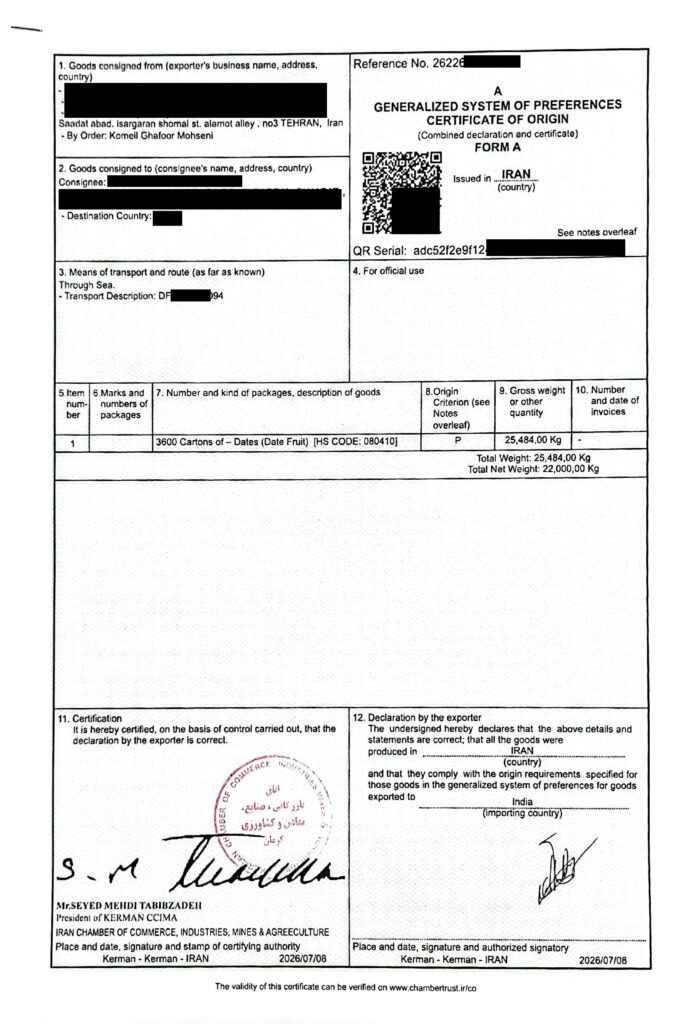
- Certificate of Origin: Confirming 100% Iranian agricultural origin.
- Commercial Invoice & Detailed Packing List: Listing exact net weight, gross weight, carton counts, and HS 0804.10 codes.
- International Road/Rail Transport Documents: Including TIR Carnet and CMR Waybill (or SMGS Rail Waybill for Sarakhs rail orders).
- Export Customs Release Declaration: Verified at the Iranian exit gate.
COO Field Note: “You can easily avoid the $250/day truck detention fee after Day 3. Simply do not wait until the driver reaches Farap to hand documents to your Uzbek broker. Instead, as soon as our team sends you the final document scan at Sarakhs, Lotfabad, or Incheh Borun, your broker should file the entry immediately.”
Bilateral Payment Security (30%–40% Advance / Border CAD) & Regional Distribution
Both new importers and long-term wholesale partners need a payment model that protects capital without slowing dispatch. Therefore, PERSA uses a clear, two-step contract settlement model:
- Step 1 — 30% to 40% Advance Payment: First, you start the order under a binding bilateral contract that protects both parties. Specifically, a 30% to 40% advance deposit starts batch allocation, 2-day quarantine sampling, and 1-day loading and shrink-wrapping.
- Step 2 — 60% to 70% Settlement Against Documents Prior to Iranian Border Exit: Next, PERSA loads your order and finalizes all export customs documents. Once the truck reaches the Iranian exit border (Sarakhs, Lotfabad, or Incheh Borun), you pay the remaining 60% to 70% balance against the shipping documents before the truck exits Iran.
From Samarkand and Bukhara to Tashkent: Cultural Kinship Driving Date Consumption
Uzbekistan and Iran share a deep historical and cultural bond. For instance, if you walk through Iran and ask about Persian poetry, people immediately mention Samarkand and Bukhara. In fact, nearly every Iranian knows Hafez’s famous verse by heart from childhood: “If that Shirazi Turk wins our heart, for her Indian mole I would give Samarkand and Bukhara.”
In modern trade, the date business makes that historic connection even sweeter. In Western markets, food factories mainly buy dates for snack production (see our guide on bulk dates for energy bar manufacturing). In contrast, families across Tashkent, Samarkand, Bukhara, and the Fergana Valley enjoy soft Iranian Rutab Mazafati, Rabbi, and Kalute dates daily with tea. Consequently, by pairing this strong local demand with 22-pallet axle math and CIP Farap cost control, Uzbek importers achieve fast inventory turnover year-round.
Frequently Asked Questions: Importing & Shipping Iranian Dates to Uzbekistan
1. Can we ship Mazafati Grade 2 dates to Uzbekistan in a non-refrigerated tent truck?
Yes, you can ship them in tent trucks from late October until just before Nowruz (mid-March). Based on PERSA’s field experience, shipping Mazafati Grade 2 (in 5 kg bulk cartons) by tent truck in autumn and winter carries low risk. Moreover, it saves the buyer $2,000 to $3,000 per truckload compared to reefer transport. Outside this window, however, exporters must ship Mazafati Grade 2 in a reefer truck below 0°C.
2. Why is the minimum order and maximum payload 22 to 24 MT per truck?
Highway laws cap the maximum gross weight of a truck on its wheels at 40 MT. Because the empty tractor and trailer weigh 15 to 17 MT with fuel and tools, the legal cargo limit is 22 to 24 MT. Loading more than 24 MT is dangerous and triggers overweight fines. Furthermore, a truck holds 22 plastic pallets for fast forklift unloading, or crews can floor-load cartons to save 400 kg of pallet weight.
3. What is the budget required for one full truckload of Iranian dates CIP Farap?
For a 22 MT truckload delivered CIP Farap border, buyers need $30,800 to $31,000 for Grade 1 Fresh Rutab Mazafati ($1,400/MT). Alternatively, budget $25,520 for Grade 2 Mazafati ($1,160/MT), or $34,100 for Dry Rabbi Grade 1 ($1,550/MT). Specifically, these prices cover dates, export cartons, shrink-wrapping, Iranian customs documents, and freight to the Uzbek border. However, they exclude Uzbek import duties and domestic transport inside Uzbekistan.
4. How do payment terms and the 3-day Free Time rule work?
First, orders start under a bilateral contract with a 30% to 40% advance payment. Next, the buyer settles the 60% to 70% balance against export documents before the truck exits the Iranian border. Once the truck exits Iran, the buyer must immediately alert their Uzbek customs broker. Consequently, the cargo clears Uzbek customs within the 3 days of Free Time, avoiding the $250/day demurrage fee.