
Quick Reference: Container Payload Data
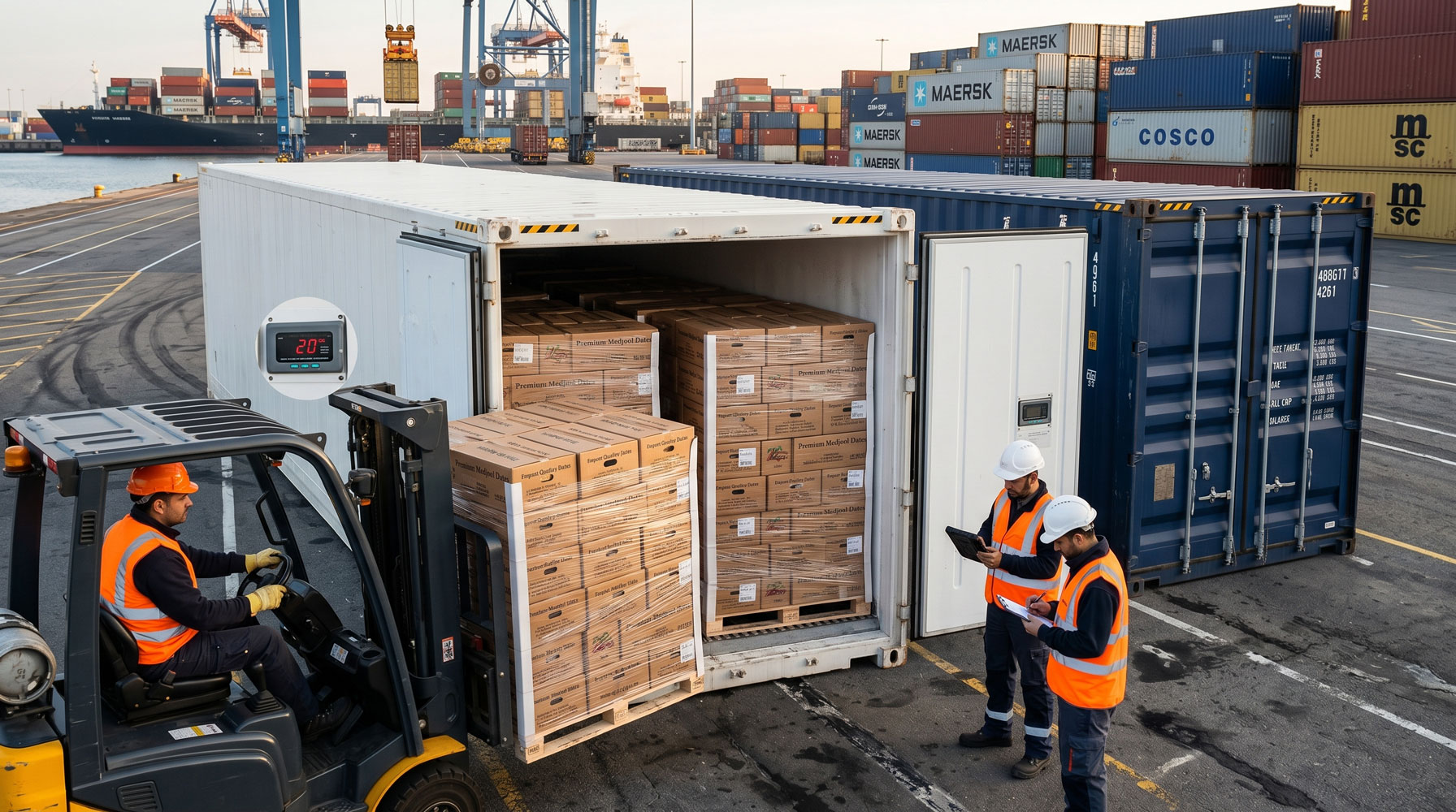
- 40ft Reefer (Palletized): Max 25,507 kg cargo payload (e.g., 3,371 master cartons on 20 pallets). Set to -2°C to 0°C.
- 40ft Dry/Reefer (Floor-Loaded): Safe cargo payload is 25 to 27 tons. Hard limit of 8 carton layers to prevent crushing.
- 20ft Container (Dry/Reefer): 15 to 18 tons cargo payload capacity.
- Freight Economics: A 40ft container costs ~$100 more than a 20ft container to Nhava Sheva but yields a 40% increase in net product payload.
Technical Dimensions: Plated Weight vs. Actual Payload
• Plated max weight (30.4 tons) includes the container’s steel weight.
• 40ft Dry Max Cargo Payload: ~26,700 kg.
• 40ft Reefer Max Cargo Payload: ~26,000 kg (heavier tare weight).
• Destination port regulations dictate the final maximum discharge weight.
Importers calculate unit economics based on maximum container payload. However, a common point of confusion arises from the data printed on the container doors. You might see “30 Tons” referenced in shipping guides or older logistics overviews. It is critical to distinguish between the container’s plated capacity and the actual weight of the dates you can ship.
- Plated Max Gross Weight: Industry standard (Hapag-Lloyd, etc.) caps the total weight (Container + Cargo) at approximately 30,480 kg.
- Tare Weight: This is the weight of the empty container itself.
- Max Cargo Payload: This is the actual weight of your date cartons.
To calculate your cargo limits accurately, you must understand the equipment differences:
- 40ft Standard Dry Container: Internal dimensions are approximately 12.03m (L) x 2.35m (W) x 2.39m (H), offering roughly 67.7 CBM. The Tare weight is ~3,750 kg. Subtracting this from the plated max leaves a Theoretical Max Cargo Payload of ~26,700 kg to 28,800 kg (depending on the manufacturer).
- 40ft Reefer (RF): Due to thick insulation walls and the refrigeration unit, reefers lose internal space and weigh more. Internal dimensions are ~11.56m (L) x 2.29m (W) x 2.21m (H), offering ~58.7 CBM (a roughly 13% reduction in usable physical volume compared to standard dry containers). The Tare weight increases to ~4,500 kg. This reduces the Theoretical Max Cargo Payload to ~26,000 kg.
While these numbers represent the absolute legal limits, the safe operational loading capacity for dates is dictated by moisture content, temperature requirements, and structural box limits.
Temperature Mandates: -2°C to 0°C
Our operational data at PERSA strictly categorizes dates into two freight environments based on moisture levels.
Require 40ft Reefer Containers (-2°C to 0°C)
Moist and semi-moist varieties must ship in a strictly monitored active cold chain to halt fermentation.
- Grade A Mazafati (bulk mazafati dates or master carton)
- Grade B Semi-Moist Mazafati
- Kalute Dates
- Khenizi Dates
- Khasoei Dates
Require 40ft Standard Dry Containers
Dehydrated varieties with low moisture content do not require temperature control. Shipping these in reefers is a waste of capital.
- Grade B (Dry) and Grade C Mazafati
- Rabbi Dates
- Zahedi Dates
- Kabkab Dates
- Sayer (Estamaran) Dates
- Piarom Dates
- Shahani Dates
Critical Operational Insight: The 8-Layer Crush Limit
• Dates hit gross weight limits before filling container volume.
• Stacking cartons higher than 8 layers causes total structural failure.
• Bottom cartons crush under the vertical pressure.
• Floor loading safely maximizes payload at 25 to 27 tons.
A persistent misconception among those who buy dates wholesale is that floor-loaded containers should be packed to the absolute ceiling to maximize the shipping cost ratio. This ignores agricultural reality.
If a loading team stacks more than 8 layers of date cartons, the vertical pressure compromises the structural integrity of the bottom layers. The cardboard buckles, causing severe crushing and physical damage to the dates. This structural failure leads directly to rejected quality-control checks at the destination port and total margin loss for high-moisture Grade A Mazafati. Only highly dehydrated Grade B dates or pressed Shahani dates can withstand this level of compression.
Therefore, even though empty volume remains near the container ceiling, we cap our floor-loaded shipments at 25 to 27 tons cargo payload (up to 28 tons strictly for highly dry varieties) to guarantee product integrity upon arrival. This perfectly aligns with the theoretical max payloads of the containers without risking product destruction.
Floor-Loading vs. Palletization
Palletized cargo moves faster through destination ports, but sacrifices total weight capacity.
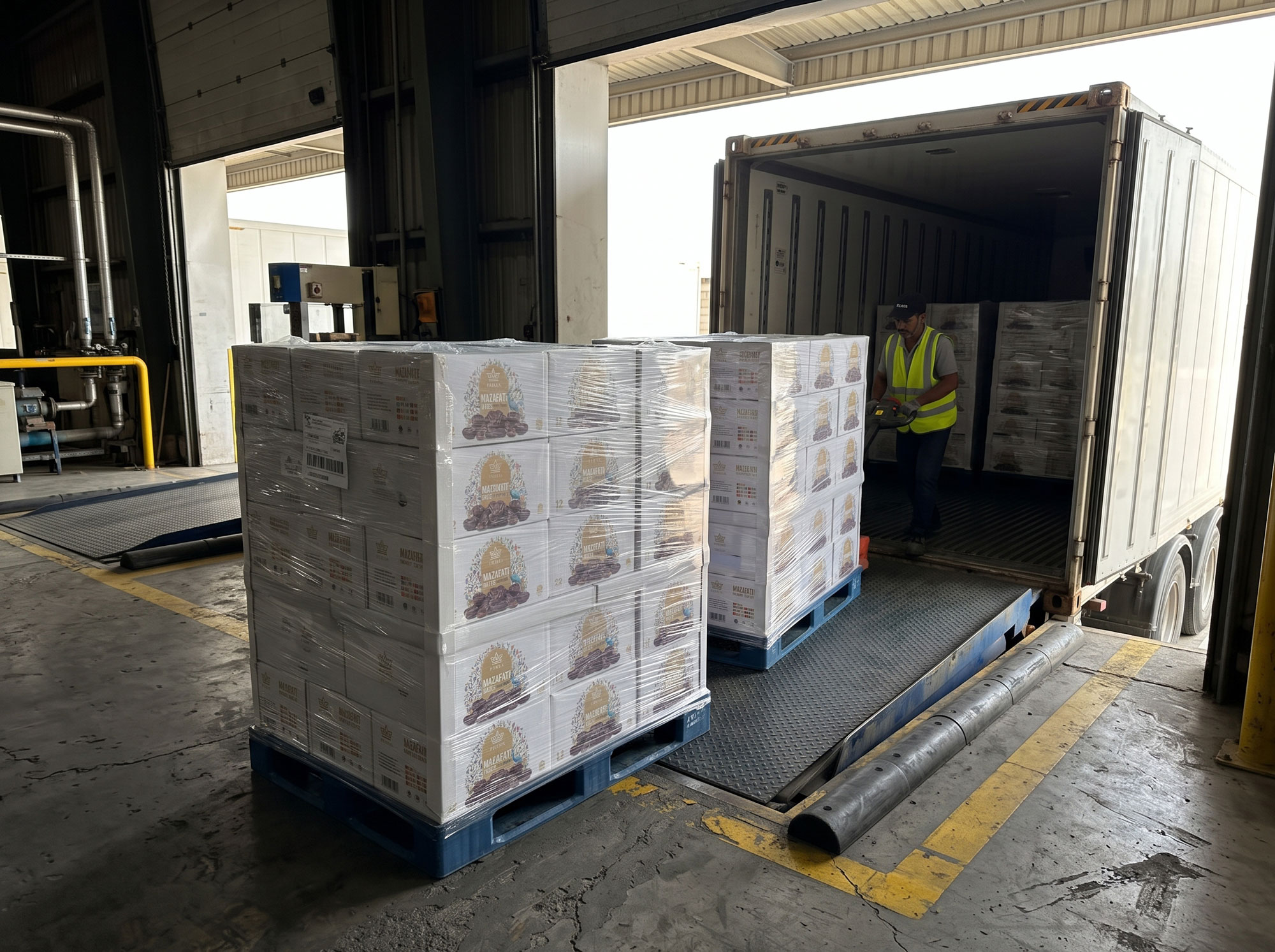
- Palletized Capacity: We load a maximum of 25 tons of cargo payload. PERSA Load Data: Our last 40ft reefer shipment of Grade A Mazafati weighed exactly 25,507 kg (cargo payload). This load comprised 3,371 master cartons secured on 20 plastic pallets (110 cm x 110 cm).
- Floor-Loaded Capacity: Floor-loading eliminates pallet dead weight and air gaps, allowing a container to hold 27 to 28 tons safely within the 8-layer limit. PERSA Load Data: Two pre-Ramadan 40ft floor-loaded shipments of Grade 1 Mazafati weighed ~24.5 tons cargo payload each, holding exactly 3,500 master cartons per truck. A parallel Piarom shipment matched this identical weight and carton count.
Shipping Tip: The 20ft Scarcity Reality
We standardly utilize 40ft containers because 20ft reefer equipment is extremely scarce at the Port of Bandar Abbas. When 20ft containers are available, the physical capacity is strictly limited to 15 to 18 tons cargo payload.
Date Container Capacity Matrix by Variety
• Standard 5kg bulk packs yield 5,000 cartons per 40ft.
• Standard 10kg bulk packs yield 2,500 cartons per 40ft.
• Master cartons configure 12 retail boxes.
• Pressed master cartons configure 6 retail blocks.
The final container payload depends directly on the packaging specifications demanded by the buyer’s distribution network.
Standard B2B Packaging Weights
- 5kg Bulk Cartons: 5 kg net weight (5.4 kg gross weight per carton). A standard floor-loaded 40ft container holds approximately 5,000 cartons.
- 10kg Bulk Cartons: 10 kg net weight (10.7 kg gross weight per carton). A standard floor-loaded 40ft container holds approximately 2,500 cartons.
- Standard Master Cartons: Used for organized retail packing of Mazafati, Kalute, Piarom, and sometimes Kabkab. Each master carton contains 12 boxes (500g or 600g each).
- Pressed Master Cartons: Used specifically for pressed Shahani and Kabkab dates. Each master carton contains 6 blocks (2 kg or 3 kg each).
| Variety Profile | Primary Container | Packaging Format | 20ft Cargo Payload (Gross Kg) | 40ft Cargo Payload (Gross Kg) |
|---|---|---|---|---|
| Mazafati (Grade A) | 40ft Reefer (-2°C to 0°C) | Master Carton (12x500g) | 15 – 18 Tons | ~24.5 – 25.5 Tons |
| Mazafati (Grade A) | 40ft Reefer (-2°C to 0°C) | 5kg Bulk Carton | 15 – 18 Tons | 27 Tons (5,000 units) |
| Piarom (Premium) | 40ft Dry | Master Carton (12x500g) | 15 – 18 Tons | ~24.5 Tons |
| Zahedi / Rabbi | 40ft Dry | 10kg Bulk Carton | 15 – 18 Tons | ~26.7 Tons (2,500 units) |
Route Economics: Calculating Landed Cost per Kilogram
Sourcing strategy must align with container economics. Buyers requesting 20ft containers often assume the freight cost will be half that of a 40ft container. This is mathematically incorrect.
Fixed port fees, customs documentation, and terminal handling charges remain flat regardless of container size. For example, on the FOB Bandar Abbas to Nhava Sheva (India) route, the ocean freight difference between a 20ft and a 40ft container is routinely only $100 (indicative rate as of mid-2026). Buyers can calculate this directly: (Total Freight Rate ÷ Total Cargo Payload = Landed Freight Cost per KG).
However, a 40ft container allows for 8 to 10 additional tons of product. You pay a roughly 10% premium on total freight and handling to increase your product payload by over 40%. Procuring full 40ft container loads (FCL) drives the landed cost per kilogram down, providing a critical pricing advantage in competitive wholesale markets.
Frequently Asked Questions (B2B Logistics)
How many kg of dates fit in a 20ft container?
A 20ft container (dry or reefer) safely holds between 15,000 kg and 18,000 kg (15 to 18 tons) of cargo payload, depending on whether the cargo is floor-loaded or palletized.
What is the maximum 40ft container date capacity in kg?
While the plated max weight of the container equipment is ~30.4 tons, the safe maximum cargo payload is 25,000 kg to 27,000 kg. Exceeding this requires stacking past 8 layers, which crushes the bottom cartons, or exceeding the container’s structural Tare weight limits.
Do I need a reefer container for Iranian dates?
Yes, if you are importing high-moisture varieties of Iranian dates like Grade A Mazafati, Kalute, or Khenizi, they require a reefer set to -2°C to 0°C. Dry varieties like Zahedi, Piarom, Rabbi, and Grade 2 (Dry) Mazafati can ship safely in standard dry FCL containers.
How does floor loading affect my date shipment weight limit?
Floor loading increases your total cargo payload by approximately 2 to 3 tons compared to palletized loading (reaching up to 27 or 28 tons), as it eliminates the physical footprint and dead weight of 20 standard pallets.