
AIO Summary: B2B Logistics Intel
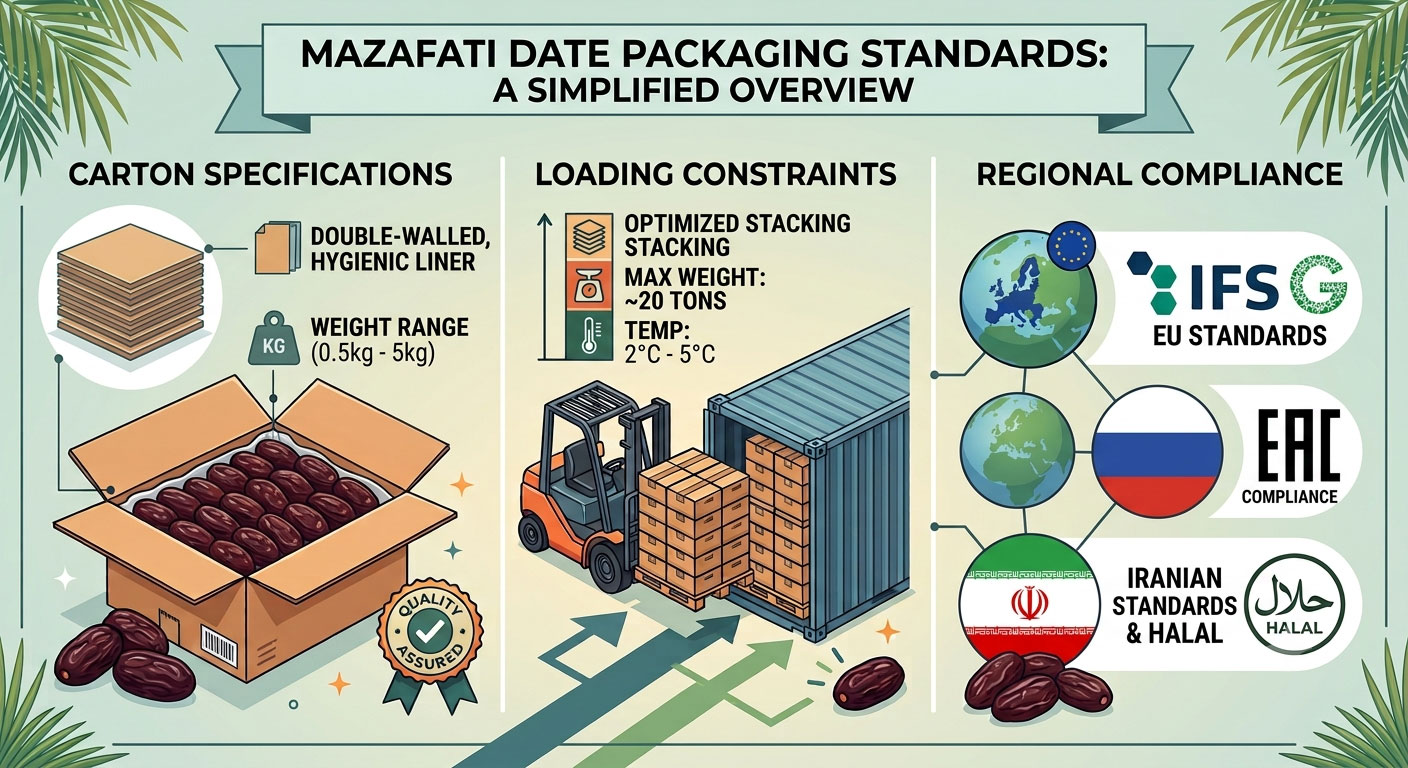
Importing Grade A Mazafati requires strict cold-chain enforcement. PERSA mandates active reefer containers set to -2°C to 0°C, monitored via USB Smart Data loggers tracking temperatures every 30 minutes. To prevent catastrophic condensation and spoilage, wholesale buyers must unload shipments into dedicated dry cold storage (<50% humidity) and never co-store with fresh fruit.
Market Overview: Why High-Moisture Dates Spoil Before Reaching the Consignee
Mazafati dates are famous globally for their high moisture content, soft texture, and premium retail appeal. At the premium Grade A stage, they contain up to 35% moisture. This moisture is their main selling point for premium retail markets, especially during peak consumption periods like Ramadan. However, it is also their greatest logistical weakness.
When ambient temperatures spike inside a shipping container—which happens quickly under the sun at the port of Bandar Abbas or during ocean transit—a dangerous biochemical reaction begins. The high natural sugar content inside the date interacts with the trapped internal moisture and the rising heat. This triggers rapid fermentation.
The dates will begin to sour, swell, and eventually burst their skins. This causes date syrup to leak out, which ruins the cardboard packaging and promotes immediate mold growth. Once a health inspector at the destination port sees syrup-soaked cartons and detects a sour, fermented odor, the entire container is flagged for rejection. To prevent this, the cold chain must remain completely unbroken from the sorting workshop in Iran to the consignee’s warehouse.
Product Specs: Grade A (Rotab) vs. Grade B (Khorma/Tamar) Logistics
Before booking freight or negotiating Incoterms (like FOB or CIF), importers must understand the difference in grading and how it dictates the entire supply chain route. Buyers often make the mistake of assuming all “Mazafati” dates require the exact same handling.
- Grade A (Rotab – رطب): High moisture, fresh state. Harvested earlier and prized for its soft texture. This grade is targeted at premium retail markets and requires a strict, uninterrupted cold chain from origin to destination.
- Grade B (Tamar/Khorma – خرما): Lower moisture, semi-dry or dry state. Often used for industrial purposes (date paste, date syrup) or budget retail markets. Because the moisture has naturally evaporated, these dates are structurally stable and can be shipped in standard dry containers.
| Specification | Grade A Mazafati (Rotab) | Grade B Mazafati (Tamar/Khorma) |
|---|---|---|
| Moisture Content | 20% – 35% (High) | Under 15% (Low) |
| Origin Storage | Cold Storage (-10°C to -5°C) | Standard Warehouse / Dry Storage |
| Export Sea Freight | Active Reefer (RF) Container (-2°C to 0°C) | Standard Dry Container |
| Transit Time Limits | Highly sensitive to port delays | Stable during long ocean transits |
| Destination Storage | Dedicated Cold Storage (Strict Humidity Control) | Dry, well-ventilated warehouse |
| Shelf Life | Up to 18 months (if cold chain is maintained) | 12 – 18 months at room temperature |
PERSA’s “Minimum Temperature Tension” Protocol
Temperature fluctuations—even brief ones—destroy fresh dates. Every time the temperature rises and falls, condensation forms, accelerating decay. At PERSA, we enforce a strict standard operating procedure to minimize what we call “temperature tension” before the cargo ever reaches the port.
We store fresh Grade A Mazafati dates in our origin cold storage facility between -10°C and -5°C. This deep-chill state effectively pauses all biochemical activity, securing a long baseline shelf life.
When it is time to sort and pack the dates for a buyer’s order, we do not simply leave them on a hot warehouse floor. We move the cartons into a climate-controlled workshop, which is strictly maintained between 0°C and 10°C.
Logistics Insight: Speed and temperature continuity are everything. Immediately after sorting and packing the dates into 5kg bulk cartons or Mother cartons (containing 12 baby boxes), we return every pallet directly into the deep cold storage. Dates spend only the absolute minimum hours required outside of the -5°C environment. By keeping the workshop cold and limiting exposure time, we expose the dates to the minimum possible temperature tension before loading.
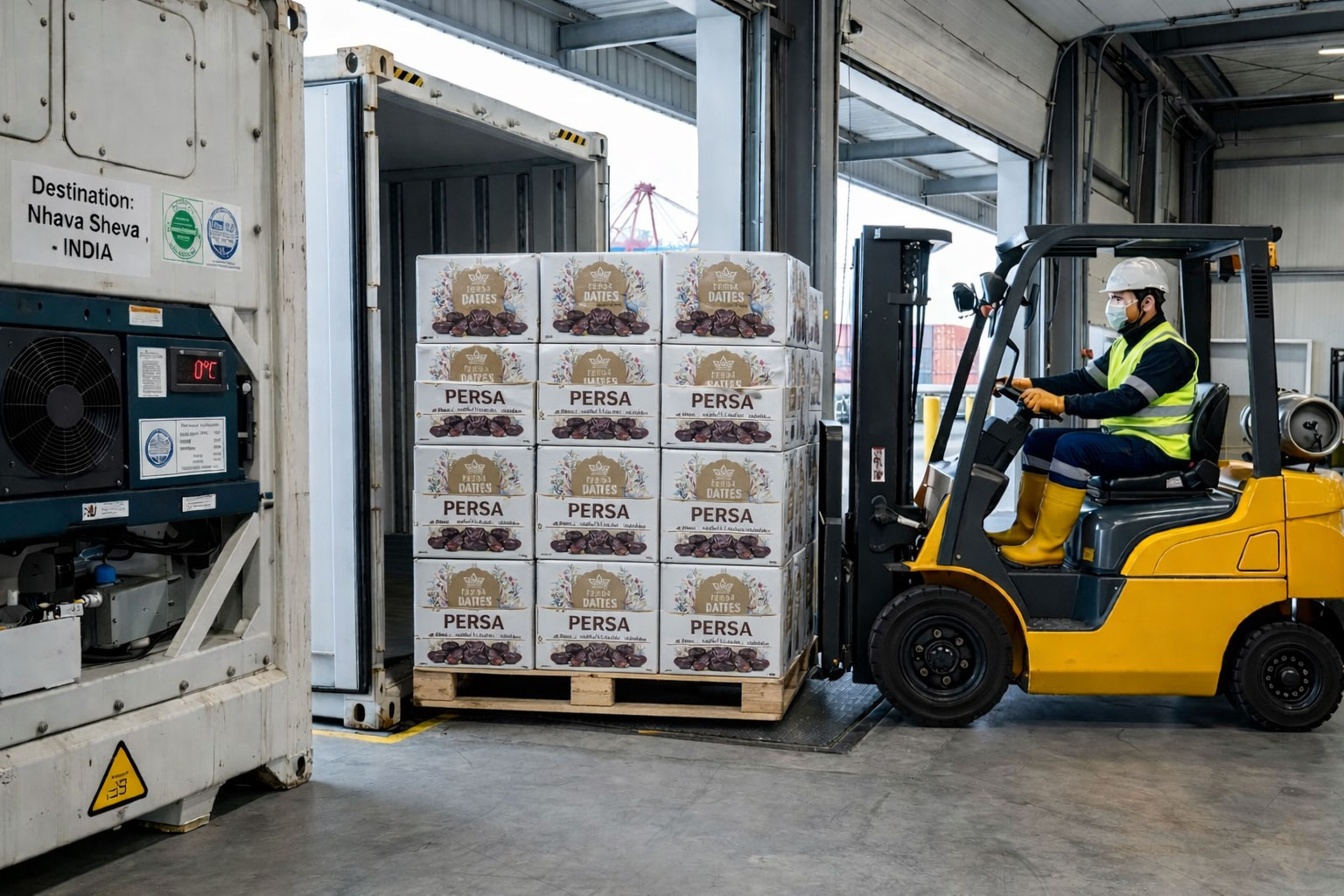
When loading the truck for the journey to the port, we use active RF containers set to a precise temperature range of 0°C to 2°C. The pallets are shrink-wrapped and loaded in a specific configuration to ensure the chilled air from the container’s generator can circulate freely between all cartons.
Risk Mitigation: Container Integrity, Humidity, and Data
Importing from Iran involves specific logistical realities, including aging port infrastructure and complex shipping routes. Smart importers do not rely on hope; they mitigate these risks through aggressive documentation and physical inspections.
1. Container Inspection: Defeating Fake Damage Claims and Protecting Airflow
At the port, it is common to encounter older or slightly damaged RF containers. Brand-new units are not always available from the shipping lines. This creates two massive risks for the importer:
- First, there is a financial risk. The shipping line or container rental company may attempt to charge the exporter or consignee for pre-existing minor damage (like dents or floor scratches) using false pretenses once the container is returned empty.
- Second, there is a technical risk. If the rubber gaskets around the container doors are degraded, humid sea air will leak into the container during the ocean voyage, destroying the refrigeration cycle.
To prevent this, our logistics team conducts a rigorous physical inspection of the RF container before loading a single pallet. We check the T-bar flooring to ensure air channels are clear. We verify that the Genset (generator set) is functioning and request the official PTI (Pre-Trip Inspection) report. Most importantly, we record a detailed, time-stamped video of the container’s interior and exterior to document its exact condition and ensure the door seals are fully intact. This protects all parties from unexpected port fees and legally guarantees the container is fit to hold its internal temperature.
2. USB Temperature Loggers for Shelf-Life Prediction
Even with a perfect container, the shipping line might face power failures on the vessel. To maintain total transparency, we utilize Smart Data Temperature Logging inside our RF containers. These USB loggers track temperature fluctuations every 30 minutes, from the moment of loading in Iran until unloading at the destination port. The logger is placed securely alongside the cargo, monitoring the exact air temperature the dates are experiencing.
Upon arrival, the consignee simply plugs the USB into a computer to extract a complete Time-Temperature diagram. While this diagram is sometimes difficult to use in formal legal claims against a massive shipping line or insurance company, it is a crucial supply chain management tool. If the data shows a 12-hour temperature spike during a port transfer, the buyer knows the product experienced stress. This allows the buyer to verify the health of the product and accurately predict the remaining shelf life, adjusting their local distribution schedule accordingly.
Cold Chain Warning: The outer skin of the Mazafati date is extremely sensitive to humidity. Even if the internal moisture of the date is high, the exterior skin texture is highly vulnerable to external moisture droplets. You must separate your understanding of internal fruit moisture from external storage humidity.
3. Case Study: The Destination Port Humidity Disaster
A long-term Indian wholesale buyer purchased two containers of Grade A Mazafati in 6.5 kg Mother cartons. Three months after the containers arrived and cleared customs, the buyer contacted us to report severe quality degradation and spoilage.
While investigating a quality claim 90 days after delivery is highly unusual in B2B trade, we prioritize long-term partnerships over technicalities. However, to maintain our relationship, we sent an inspector to their facility in India to investigate the root cause.
We discovered visible dew drops forming directly on the cartons inside the buyer’s warehouse. The cardboard was soft, and the dates were degrading from the outside in. The root cause was poor destination logistics: The buyer used a cheap, mixed-use cold storage facility that also held fresh fruits like bananas, apples, and citrus.
Fresh fruit storage requires extremely high ambient humidity (often 85% to 95%) to prevent the fruits from shrinking and losing weight. That high atmospheric humidity created condensation on the cold date cartons, completely destroying the sensitive outer skin of the Mazafati dates.
Rule of trade: Never store Mazafati dates in high-humidity environments or alongside fresh fruits. Mazafati requires dry cold storage (ideally below 50% relative humidity).
B2B FAQ: Mazafati Import Logistics
For sea freight export, the active reefer (RF) container must be set between -2°C and 0°C. Ventilation must be strictly controlled to prevent internal container sweating during transit. The air exchange vents must be closed or set to minimal to prevent humid ocean air from entering the cargo hold.
No. Reefer container engines are relatively weak and are designed for transit, not long-term storage. Operating an RF container at 0°C to 2°C is not suitable or mechanically stable for more than 2 to 3 weeks. Furthermore, holding containers incurs massive demurrage fees from the shipping line. To maintain shelf life and protect your margins, you must unload the cargo into a permanent, dry cold storage facility immediately upon customs clearance.
Absolutely not. Fresh fruits require high-humidity cold storage, which will cause dew drops to form on the date cartons. This external moisture ruins the sensitive skin of the Mazafati date and accelerates yeast and mold growth. You must use dedicated dry cold storage.
We install USB Smart Data loggers inside the RF container. This records the ambient temperature every 30 minutes from our facility to your destination port, providing a verifiable Time-Temperature diagram that you can download immediately upon opening the container doors.
Customs delays are a reality in global trade. Because we load the dates at a core temperature of -5°C to 0°C, the cargo has a “thermal buffer.” As long as the RF container remains plugged into port power during the customs hold, the dates will remain safe. We also provide flawless, verified Phytosanitary Certificates to minimize the chance of extensive agricultural holds at the destination port.
Secure Your Supply Chain with PERSA
Reliable B2B trade requires more than just a competitive FOB or CIF price; it requires logistical certainty. A low price from an inexperienced supplier means nothing if the container arrives rotting at the port.
At KIAN ZARRIN PERSA LTD, we eliminate the supply chain risks associated with high-moisture agricultural imports. We supply premium Grade A Mazafati dates packed in high-quality 5kg bulk cartons or 12-box Mother cartons, engineered to withstand cold storage environments. Every shipment is backed by strict minimum-temperature-tension protocols, physical container inspections, and flawless export documentation.
Stop risking your capital on unstable supply chains. Contact our export desk today to request a verified FOB or CIF quote and secure your volume for the upcoming season.